
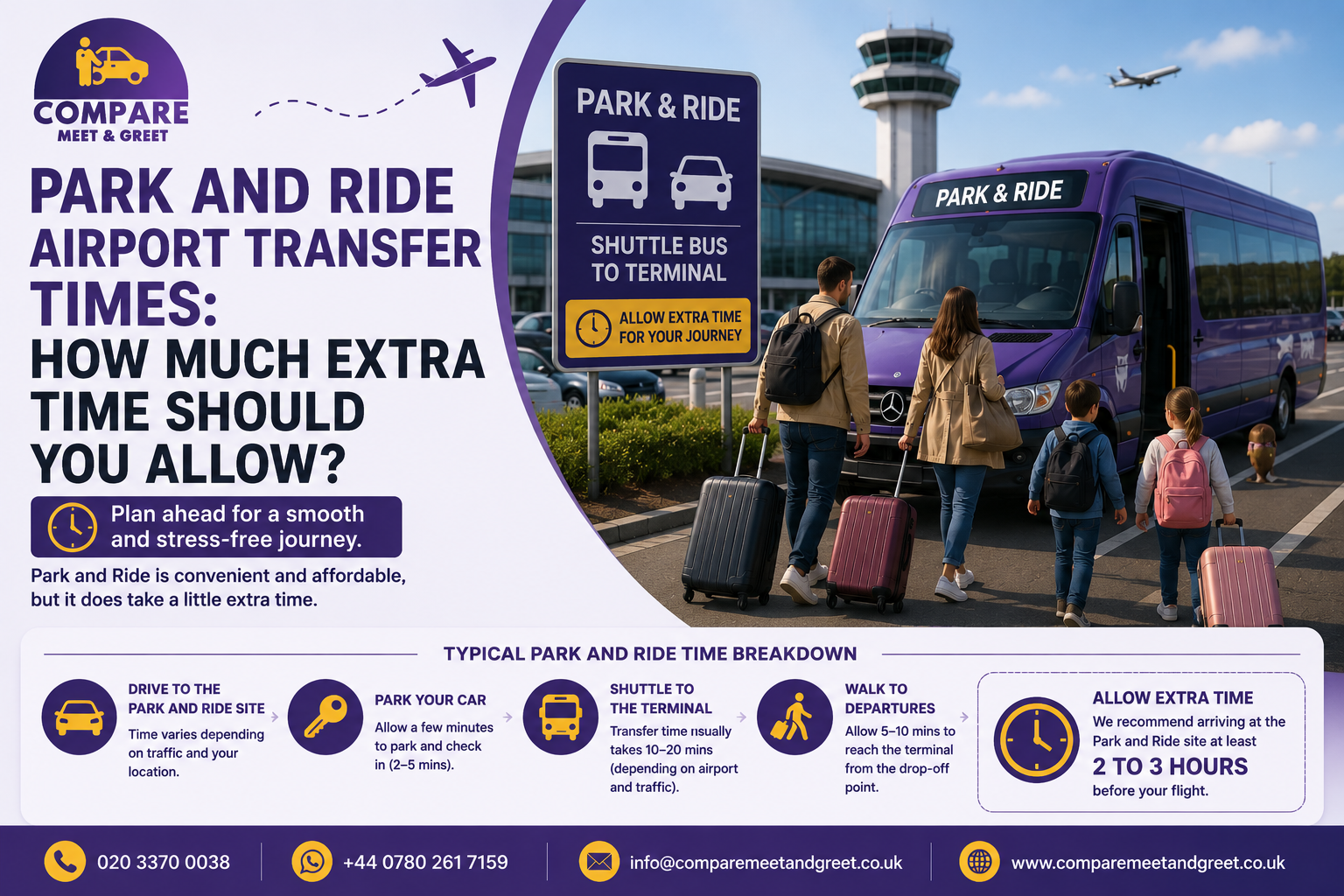
A Park and Ride airport transfer time is often advertised as approximately five to 20 minutes, but that usually refers only to the shuttle journey. The full time from arriving at the car park to entering the terminal can be 30 to 60 minutes or longer after allowing for entry, finding a space or checking in, unloading luggage, walking to the bus stop and waiting for the next shuttle.
There is no single allowance that works for every airport or provider. A compact car park with buses every 10 minutes may be quick and predictable. A larger off-airport site with reception check-in, an on-demand bus or heavy traffic can take considerably longer.
As a sensible starting point, many travellers should plan to reach a Park and Ride car park around 45 to 60 minutes before the time they want to be inside the terminal. Families, passengers with substantial luggage, users of infrequent or on-demand transfers and anyone travelling during a busy period may need more. Always follow the individual provider’s instructions when they specify a longer allowance.
This extra parking time comes before the airport’s recommended check-in or security arrival time. If the airport advises reaching the terminal three hours before an international flight, you must work backwards from that terminal time and then add the complete Park and Ride process.
This guide explains how to calculate a realistic allowance and avoid starting your journey under unnecessary pressure.
What Is the Average Park and Ride Airport Transfer Time?
The shuttle journey itself commonly falls within a broad five-to-20-minute range, although some car parks are closer and others are farther away. This is only a planning range, not a promise for any specific service.
The complete journey normally includes:
- entering the car park;
- finding a parking bay or checking in at reception;
- unloading passengers and luggage;
- walking to the shuttle stop;
- waiting for the bus;
- travelling to the terminal; and
- walking from the drop-off point into departures.
A product advertised as a 10-minute transfer could therefore take 30, 40 or even 60 minutes from car park entrance to terminal, depending on the circumstances.
The safest comparison is not “Which bus ride is shortest?” It is “How long could the whole parking-to-terminal process reasonably take?”
How Much Extra Time Should You Allow for Park and Ride?
Use the following broad planning guide:
| Situation | Suggested planning allowance before your target terminal arrival | Why more or less time may be needed |
|---|---|---|
| Solo traveller, cabin bag, frequent shuttle | 30–45 minutes | Faster parking and luggage handling |
| Typical couple with checked luggage | 45–60 minutes | Parking, unloading and possible bus wait |
| Family with children and several bags | 60–75 minutes | More time to unload, supervise and board |
| On-demand or infrequent shuttle | 60–90 minutes | Less predictable waiting time |
| Oversized luggage or mobility requirements | 60–90+ minutes | Assistance or special boarding arrangements |
| Peak holiday or known disruption | Add a further buffer | Queues, busy buses and road congestion |
These are planning ranges rather than guarantees. If the provider tells you to allow a specific amount of time, follow that instruction. Add more time if roadworks, weather warnings, airport disruption or terminal changes are expected.
Remember that this allowance ends when you reach the terminal. It does not replace the airport’s guidance about check-in, bag drop or security.
How to Calculate Your Park and Ride Arrival Time
Work backwards from the time you want to enter the terminal.
For example:
- You want to be inside departures at 06:00.
- You choose a Park and Ride allowance of 60 minutes.
- You should aim to reach the car park at approximately 05:00.
- You then calculate the drive from home and add traffic contingency.
The calculation is:
Target terminal arrival − complete Park and Ride allowance = target car park arrival
Then calculate when to leave home:
Target car park arrival − expected driving time − road buffer = home departure time
Do not use the flight departure time as the car park arrival time. You still need to complete the transfer, check in, pass through security and reach the gate.
The Seven Parts of the Full Park and Ride Transfer
1. Entering the Car Park
Entry may use automatic number-plate recognition, a barcode, a ticket or reception check-in. When everything works correctly, this may take only a few minutes. It can take longer if:
- the registration was entered incorrectly;
- the barrier does not recognise the booking;
- several vehicles arrive together;
- you enter the wrong lane; or
- staff need to locate the reservation.
Check the confirmation before leaving home and approach the correct entrance. If an ANPR barrier does not open, use the assistance button rather than taking a new ticket unless instructed.
2. Finding a Space or Checking In
At a self-park site, you may need to drive through several zones before finding a bay. A large car park can add more time during busy periods.
At an operator-parked service, you normally stop in an arrivals lane, unload and report to reception. Staff may inspect the vehicle or issue a collection receipt before taking the keys.
Neither method is automatically faster. Self-parking can involve searching and walking; operator parking can involve a queue. Read the process before deciding how much time to allow.
3. Unloading Luggage and Passengers
A solo traveller with one cabin bag can unload quickly. A family with cases, pushchairs, car seats and children will take longer.
Before travel:
- organise luggage in the boot;
- keep travel documents accessible;
- reduce loose items;
- know who will supervise children; and
- check that nothing essential remains in the vehicle.
Once a vehicle has been handed over and moved, retrieving a forgotten item may create a significant delay.
4. Walking to the Bus Stop
At some car parks, the shuttle leaves from reception. At others, you walk from the parking bay to an internal stop.
Walking time depends on:
- the size of the site;
- which zone has spaces;
- luggage quantity;
- mobility;
- weather;
- lighting; and
- path surfaces.
Do not assume luggage trolleys will be available. Choose a bay near a stop when permitted and record the zone for your return.
5. Waiting for the Shuttle
This is often the most variable part. A bus advertised as running every 15 minutes could arrive immediately—or just after you reach the stop, leaving nearly a full interval to wait.
The service may be:
- scheduled;
- frequent and continuous;
- dispatched when full;
- on demand after a telephone call; or
- less frequent overnight.
Check both the bus frequency and operating hours. A five-minute road journey with buses every 30 minutes may be slower overall than a 15-minute journey with a bus every 10 minutes.
6. Travelling to the Terminal
The advertised Park and Ride airport transfer time usually refers to this stage. Journey time depends on distance, terminal, airport roads, traffic and the number of stops.
An on-airport bus may use dedicated internal roads, while an independent off-airport provider may travel through public traffic. Multi-terminal routes can add time if your terminal is the final stop.
Treat a quoted duration as an estimate under normal conditions, not a guaranteed arrival time.
7. Walking From the Drop-Off Point to Departures
The shuttle may stop immediately outside the terminal, at a bus station or at a transport interchange connected by a walkway. The transfer is not complete until you and your luggage reach the correct check-in or departures area.
Check whether:
- the route is covered;
- lifts or level access are available;
- the stop serves your terminal directly; and
- luggage trolleys are available at the airport.
Large terminals can add several minutes after leaving the bus.
Bus Journey Time vs Total Transfer Time
This distinction is essential when comparing airport parking.
| Time description | What it usually includes | What it may exclude |
|---|---|---|
| Shuttle journey time | Time riding the bus | Parking, walking and waiting |
| Bus frequency | Expected gap between services | Queues and capacity issues |
| Total transfer allowance | Complete car park-to-terminal process | Drive from home and airport check-in |
Consider a car park advertising a 10-minute shuttle every 20 minutes. A realistic journey could be:
- entry and parking: 10 minutes;
- unloading and walking: 10 minutes;
- bus wait: up to 20 minutes;
- shuttle journey: 10 minutes;
- terminal walk: five minutes.
The complete time could be around 35 to 55 minutes even though the advert says “10-minute transfer”. The advertised statement may be accurate; it simply describes one stage.
Does Bus Frequency Matter More Than Distance?
It can. Two car parks may be five and 15 minutes from the terminal, but the closer car park could have a less frequent service.
Compare the worst reasonable waiting time:
- A five-minute journey with buses every 30 minutes may take up to 35 minutes from reaching the stop.
- A 15-minute journey with buses every 10 minutes may take up to 25 minutes from reaching the stop.
This simplified example does not include traffic or capacity, but it shows why the shortest advertised transfer is not always fastest overall.
Frequent buses can also make the return journey easier because passengers spend less time waiting after a long flight.
Do On-Airport and Off-Airport Transfers Take Different Amounts of Time?
On-airport Park and Ride is located within or beside the airport estate. Off-airport services operate from an independent site outside it.
On-airport products may have:
- shorter routes;
- clearly designated airport stops;
- frequent scheduled buses; and
- less travel on public roads.
Off-airport products may offer:
- lower prices;
- a convenient location on your driving route;
- direct service to selected terminals; and
- on-demand transfers.
These are general tendencies, not rules. A well-located independent car park can be faster than a large official facility, while road traffic can affect either type. Compare the exact address, timetable and terminal route.
Park and Ride Transfer Times at Major UK Airports
Transfer arrangements vary by terminal and product, and they can change. The following examples show why airport-specific checking matters.
Heathrow Airport
Heathrow’s official Park & Ride service uses different car parks and routes according to the terminal. Official information indicates that buses generally operate at regular intervals, while the journey varies by terminal and traffic. The official product was formerly called Long Stay parking.
Read our Heathrow Long Stay parking guide for more context. If avoiding the bus is important, compare Heathrow Meet and Greet airport parking. For short visits or close terminal access, Heathrow Short Stay parking may be more suitable.
Gatwick Airport
Gatwick’s official Long Stay parking uses shuttle buses to the terminals, while independent Park and Ride services may use separate sites and routes. Confirm whether the selected product serves North Terminal, South Terminal or both.
The complete transfer should include any waiting time and movement from the bus stop into the terminal. Travellers who prefer to avoid a shuttle can compare Gatwick Meet and Greet airport parking.
Manchester Airport
Manchester JetParks products use shuttle connections, with the correct route depending on the selected site and terminal. Check the current product description rather than assuming every JetParks bus has the same journey.
If terminal convenience is more important than the lowest price, compare Manchester Meet and Greet airport parking.
Bristol Airport
Bristol Airport’s Silver Zone uses a reception, key handover and courtesy bus. The bus journey is only part of the allowance because customers also need to check in and unload.
For an alternative without the usual remote-car-park transfer, compare Bristol Meet and Greet airport parking.
How Much Extra Time Should Families Allow?
Families usually need more time than solo travellers. Parking and boarding involve supervising children while unloading cases, pushchairs and hand luggage.
A family might reasonably allow 60 to 75 minutes between reaching the car park and the desired terminal arrival, with more time for:
- babies or toddlers;
- one adult travelling with several children;
- a pushchair or travel system;
- multiple large suitcases;
- unfamiliar car parks;
- early or late flights; and
- infrequent buses.
The provider’s recommendation remains the starting point. If it instructs passengers to allow 90 minutes, follow that guidance.
Assign one adult to children and another to luggage where possible. Prepare coats, documents and bags before arriving so the family does not need to reorganise beside the bus.
How Much Extra Time Should You Allow With Heavy Luggage?
Heavy or bulky luggage can add time during unloading, walking, boarding and terminal access. A broad allowance of 60 to 90 minutes may be appropriate when you have several cases, sports equipment, a pushchair or mobility equipment, but the exact requirement depends on the service.
Contact the provider before booking if an item needs special handling. Confirm:
- whether the shuttle accepts it;
- whether assistance is available;
- accessible boarding arrangements;
- luggage storage; and
- the walking distance to stops.
Do not assume an item accepted by the airline will fit every parking shuttle.
How Do Early-Morning Flights Affect Transfer Time?
Early flights can be among the busiest times for airport parking because many passengers arrive within a narrow window. Overnight bus frequencies may also differ from daytime service.
Before travelling, check:
- whether the car park is staffed;
- whether buses operate continuously or on demand;
- the overnight timetable;
- reception check-in requirements;
- road closures; and
- the correct terminal.
Prepare the vehicle and luggage the night before. Save directions and the booking number, and add a larger buffer if you have never used the car park.
Being early is normally less disruptive than missing a shuttle and rushing through the terminal.
How Do Peak Travel Periods Affect Park and Ride Times?
School holidays, summer weekends, bank holidays and Christmas can increase demand. More vehicles may arrive together and shuttle buses can be busier.
Possible delays include:
- queues at entry;
- fewer available bays near stops;
- longer walks;
- reception queues;
- full buses;
- congestion on airport roads; and
- longer terminal drop-off times.
Allow a further buffer during busy dates and check airport travel alerts. Pre-booking secures the product according to its terms, but it does not guarantee that every stage will be free from queues.
What If You Miss the Shuttle?
For a frequent scheduled service, you normally wait for the next bus. The impact may be small if buses run every 10 minutes and more significant if the interval is 30 minutes.
For an on-demand service, contact the operator according to the booking instructions. Do not assume a bus will return automatically.
Missing a shuttle is one reason to build waiting time into your plan. An itinerary that works only if a bus arrives immediately is too tight.
What If the Shuttle Is Full?
Capacity can be limited during busy periods, particularly when passengers have large quantities of luggage. The driver or staff may ask some passengers to wait for the next service.
To reduce the risk:
- arrive with a reasonable buffer;
- avoid unnecessary loose baggage;
- follow loading instructions;
- use the correct stop; and
- allow extra time during peak travel dates.
If capacity or accessibility is a particular concern, ask the operator about arrangements before booking.
What If Traffic Delays the Bus?
Off-airport transfers can be affected by public-road congestion, while on-airport buses can face queues around terminal roads. Roadworks, incidents, severe weather and airport restrictions can lengthen the journey.
Check traffic and airport updates before leaving home. A quoted transfer time is normally an estimate under typical conditions, so build in contingency rather than treating it as a guaranteed maximum.
What If You Go to the Wrong Terminal?
Using the wrong terminal route can add substantial time. Confirm the terminal shown by the airline and parking provider shortly before travel.
If the airline changes terminal after booking:
- Check whether the shuttle serves the new terminal.
- Amend the parking booking if required.
- Ask the provider about inter-terminal travel.
- Add time for any extra connection.
Do not assume every car park bus serves every terminal.
How Long Does the Return Transfer Take?
The same advertised shuttle journey applies in the opposite direction, but the complete return process begins after baggage reclaim and ends when you can drive away.
Include:
- walking to the pickup point;
- locating the correct stop;
- calling the provider if required;
- waiting for the bus;
- travelling to the car park;
- finding the bay or collecting keys;
- loading luggage; and
- exiting the barrier.
The return can take longer if several flights land together, the service is on demand or vehicles must be prepared for collection.
Do not book the car park exit for the scheduled landing time. Allow for disembarking, passport control, baggage reclaim and the transfer.
What Happens If Your Return Flight Is Delayed?
A delayed landing can move your return into a less frequent overnight period and extend the parking stay. Check:
- whether the shuttle operates 24 hours;
- whether you must call after a certain time;
- the grace period;
- additional hourly or daily charges; and
- whether the provider tracks flights.
Entering a flight number can help the operator identify the journey, but it does not guarantee free extra parking. The booking terms determine any charge.
Park and Ride vs Meet and Greet: Which Is Faster?
Meet and Greet is usually faster between the vehicle handover and terminal because it removes the remote-car-park shuttle. You normally leave the car at a designated terminal-area point and walk to departures.
| Timing factor | Park and Ride | Meet and Greet |
|---|---|---|
| Parking location | Away from terminal | Handover near terminal |
| Shuttle wait | Required | Usually none |
| Bus journey | Required | Usually none |
| Vehicle process | Park or check in remotely | Inspect and hand over near terminal |
| Typical priority | Lower cost | Faster terminal access |
Meet and Greet still requires time for finding the handover point, vehicle inspection and check-in. On return, you may need to call and wait for the vehicle according to the service instructions.
Compare the total price and process. A modest premium may be worthwhile for families, heavy luggage or a tight schedule, but Park and Ride can offer better value when you allow sufficient time.
Park and Ride vs Long Stay Transfer Times
Many Long Stay products use the same shuttle model as Park and Ride. At some airports, the names even describe the same service. Therefore, one category is not automatically faster.
Compare:
- car park address;
- bus frequency;
- journey time;
- terminals served;
- number of stops;
- parking or reception procedure; and
- overnight arrangements.
The label “Long Stay” or “Park and Ride” does not reveal the full transfer time.
Ways to Reduce Your Park and Ride Transfer Time
Pre-book and enter accurate details
Correct number-plate and vehicle information can make barrier entry smoother.
Read the directions before leaving
Going to the wrong car park or airport entrance can cost more time than the shuttle journey itself.
Organise luggage at home
Keep documents and essential items accessible. Reduce loose bags and ensure every case can be moved easily.
Choose a suitable parking bay
Where possible, park near a shuttle stop without using reserved or accessible bays improperly.
Record the bay and stop
Photograph the location to shorten the return process.
Know the bus schedule
Check frequency, operating hours and whether an overnight call is required.
Confirm the terminal
Verify it shortly before travel and update the parking provider if necessary.
Keep the return instructions accessible
Save the pickup point and telephone number before flying.
Park and Ride Timing Checklist
Before booking:
- Check the advertised bus journey.
- Check how often buses run.
- Confirm the shuttle serves your terminal.
- Read the parking or reception process.
- Check overnight arrangements.
- Review accessibility and luggage needs.
- Compare the full transfer, not only the journey.
Before leaving home:
- Confirm your target terminal arrival.
- Subtract the complete Park and Ride allowance.
- Add driving time and a road buffer.
- Save the directions and booking reference.
- Check live traffic and airport information.
At the car park:
- Follow the correct entry instructions.
- Unload efficiently but safely.
- Record your parking location.
- Confirm the bus destination.
- Keep enough buffer for the next shuttle.
Frequently Asked Questions
What is a typical Park and Ride airport transfer time?
The bus journey is often around five to 20 minutes as a broad planning range, but products vary. The full car park-to-terminal process can take 30 to 60 minutes or longer after parking, unloading, walking and waiting.
How early should I arrive at Park and Ride airport parking?
Many travellers should consider reaching the car park around 45 to 60 minutes before their desired terminal arrival. Families, heavy luggage, infrequent buses and busy periods may require 60 to 90 minutes or more. Follow the provider’s own guidance.
Does the advertised transfer time include waiting for the bus?
Usually, an advertised transfer time refers to the approximate bus journey. It may exclude parking, unloading, walking and waiting. Check how the provider defines the time.
How often do Park and Ride airport buses run?
Frequency varies. Buses may run every few minutes, follow a timetable or operate on demand. Overnight service may differ from daytime arrangements.
Is an on-airport Park and Ride transfer always faster?
No. On-airport products can have shorter routes, but car park size, waiting time, terminal stops and traffic all matter. Compare the complete service.
How much time should families allow for Park and Ride?
A broad planning allowance of 60 to 75 minutes before the target terminal arrival may be sensible, with more time for babies, pushchairs, several bags or infrequent buses. Follow the provider’s instructions.
Does Park and Ride time replace the airport check-in allowance?
No. The Park and Ride allowance gets you from the car park to the terminal. You must then meet the airport or airline’s recommended check-in, bag-drop and security timing.
How long does the return shuttle take?
The bus journey may be similar to the outbound trip, but the full return includes finding the stop, waiting, travelling, collecting the car and leaving the car park.
What happens if I miss a shuttle bus?
You normally wait for the next scheduled bus or contact an on-demand provider. The impact depends on frequency, which is why your plan should not rely on immediate pickup.
Is Meet and Greet faster than Park and Ride?
Meet and Greet usually provides faster terminal access because it removes the shuttle stage. However, allow time for vehicle handover and follow the return collection instructions.
How Much Park and Ride Time Should You Really Allow?
A Park and Ride airport transfer time should never be judged only by the advertised bus journey. The complete process includes car park entry, parking or check-in, unloading, walking, waiting, travelling and reaching departures from the terminal stop.
For many travellers, arriving at the car park 45 to 60 minutes before the desired terminal arrival is a sensible starting point. Families, passengers with heavy luggage, mobility requirements, on-demand buses or peak-time journeys may need 60 to 90 minutes or longer. The provider’s specific recommendation should take priority.
Work backwards from the time you need to be inside the terminal, add the entire parking transfer and then add the drive from home. A generous, realistic buffer protects the flight and makes Park and Ride a calmer start to the journey.