
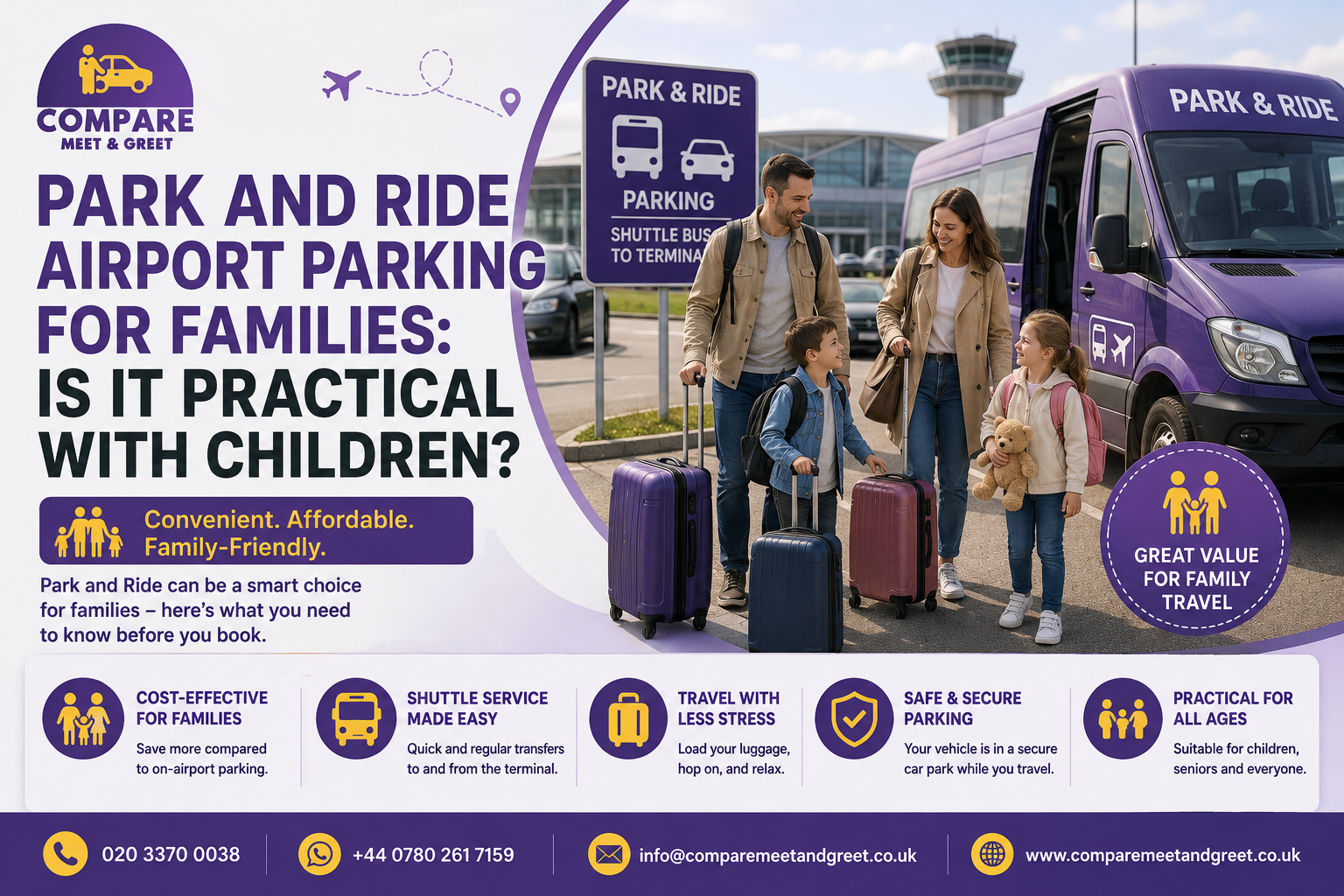
Park and ride airport parking for families can be practical and cost-effective, particularly when children can manage a short shuttle journey and the family is not carrying excessive luggage. However, it adds several steps that terminal parking and Meet and Greet can avoid: unloading the car, moving everyone to a bus stop, waiting for the shuttle, loading bags and pushchairs, and repeating the process after the return flight.
Whether it suits your family depends on your children’s ages, the number of adults travelling, the amount of luggage, the transfer frequency, the time of the flights and whether anyone needs mobility assistance. A frequent shuttle from a well-organised car park may be straightforward. A longer, less frequent transfer at 4am with a baby, two suitcases and a folded pushchair may feel very different.
The best decision is not simply the cheapest airport parking. Compare the complete family journey, including how easily everyone can travel between the car and terminal.
This guide explains when Park and Ride works well with children, what to check before booking and when paying more for a closer option may be worthwhile.
Is Park and Ride Airport Parking Practical for Families?
Yes, Park and Ride can be practical for families if the shuttle is frequent, the journey is short and the luggage is manageable. Many families use shuttle-connected airport parking because it can cost less than terminal-adjacent alternatives, especially for a week or two.
It is likely to work well when:
- two adults can share responsibility for children and bags;
- children are old enough to walk and follow instructions;
- luggage has been kept under control;
- the bus stop is close to the parking bay or reception;
- transfers run frequently at the required times;
- the journey serves the correct terminal directly; and
- the family has allowed extra time.
It may be less practical when:
- one adult is travelling alone with several young children;
- you have a baby, pushchair, car seats and multiple cases;
- someone in the group has limited mobility;
- the shuttle is infrequent or requires a call;
- the car park has a long transfer;
- the outbound or return journey is overnight; or
- the price difference to Meet and Greet is small.
Park and Ride is neither automatically family-friendly nor automatically unsuitable. The individual product and your family’s circumstances determine the answer.
How Does Park and Ride Work With Children?
The normal family Park and Ride journey involves the following stages:
- Drive to the booked car park.
- Enter using number-plate recognition, a code or reception check-in.
- Find a bay or hand over the vehicle and keys.
- Unload children, suitcases, hand luggage, pushchairs and other equipment.
- Walk to the shuttle stop.
- Wait for and board the correct bus.
- Load luggage as directed and travel to the terminal.
- Unload the group and walk to departures.
- After the holiday, locate the return bus stop and repeat the transfer.
- Find the vehicle or collect the keys, reload everything and leave.
Each step is simple on its own, but travelling with children increases the number of moving parts. Good preparation matters more than it does for an adult travelling with one cabin bag.
Before booking, visualise the process from the moment you open the car doors to the moment everyone enters the terminal. If one adult will have to manage two children, a pushchair and several cases simultaneously, a low headline price may not represent the best value.
Advantages of Park and Ride Airport Parking for Families
It Can Cost Less for a Family Holiday
Park and Ride is often positioned as a lower-cost option for stays of several days. This can be attractive for families already paying for multiple flights, checked bags, accommodation and other travel costs.
Parking is charged mainly for the vehicle and stay rather than by the number of children, although you should confirm that the transfer is included for all passengers. A family may therefore make a meaningful saving compared with premium terminal parking.
Prices change according to the airport, dates, availability and booking conditions. Compare the final total for identical times rather than relying on an advertised daily rate.
It Can Suit Longer Trips
Park and Ride car parks are generally designed for holiday and multi-day parking. A week or two away may be much better suited to this type of car park than Short Stay parking.
Longer bookings can make the saving more significant, but do not assume the cheapest category always wins. Compare Park and Ride, Long Stay and Meet and Greet for the exact dates.
The Shuttle Can Feel Like Part of the Journey
Older children may enjoy the bus ride and the sight of aircraft, terminals and airport vehicles. A short transfer can help break up the journey between a long car ride and waiting inside the terminal.
This advantage depends on timing. A calm daytime bus journey with seats and space is different from a busy shuttle during an early-morning peak.
Self-Park Products Can Let You Keep the Keys
Some Park and Ride services allow families to choose a bay, lock the car and retain the keys. Parents who prefer the vehicle to remain where they left it may value this arrangement.
Other products require key handover, so check the description carefully. “Park and Ride” does not guarantee that you keep your keys.
It Can Offer More Space to Organise Before the Terminal
A remote car park may give you a moment to organise coats, travel documents and hand luggage before reaching the busy terminal. Families can check that everyone has what they need before boarding the shuttle.
Use this time efficiently. Prepare passports and essential items before leaving home rather than opening several suitcases in the car park.
Challenges of Park and Ride With Children
Moving Luggage Between the Car and Bus
The biggest practical issue is luggage handling. Everything must leave the car, reach the bus, be loaded and then be removed at the terminal. The process is repeated after the return flight when children may be tired.
Family luggage can include:
- checked suitcases;
- cabin bags;
- changing bags;
- pushchairs;
- travel cots;
- car seats or booster seats;
- coats and blankets; and
- children’s personal bags.
Count the number of items before travelling. If the adults cannot carry the luggage while safely supervising the children, reduce the load or choose another parking method.
Folding and Handling a Pushchair
Some shuttle arrangements may require a pushchair to be folded and stored with luggage. Others may have different accessibility and space policies. Confirm the individual provider’s rules rather than assuming the pushchair can remain open.
Practise folding the pushchair quickly before the trip. Remove loose toys, cup holders and accessories that might fall off. Use a strap or travel cover if suitable, and keep anything needed during the bus journey in a small accessible bag.
Waiting for the Shuttle
The advertised transfer time usually describes only the bus journey. The family may also need to wait for the next service.
Compare:
- daytime and overnight frequency;
- whether the bus follows a timetable;
- whether a phone call is required;
- whether stops have shelter and seating; and
- expected capacity during busy periods.
A 10-minute journey with a 30-minute wait can be harder with children than a 15-minute journey on a frequent service.
Boarding During Busy Periods
School holidays are naturally popular with families, which can make buses and car parks busier. Allow extra time for check-in, parking and transfers.
Keep children close while passengers load luggage. Do not leave a child unattended while one adult places bags in the luggage area. When two adults are travelling, agree who supervises the children and who handles the cases.
Managing the Return Journey
The outbound journey is easier to plan because the family begins rested and together at the car. The return can be more demanding after a delayed flight, passport-control queue or long wait for bags.
Before travelling, save:
- the return bus-stop location;
- whether you must call the operator;
- the car park telephone number;
- the parking zone, row and bay; and
- the key-collection instructions.
Photograph the bay marker and nearest bus stop. After a week away, relying on memory is risky.
Park and Ride With Babies
Travelling with a baby requires the most planning because you may be carrying a pushchair, changing bag, milk or feeding equipment, and possibly a travel cot or car seat.
Before booking, ask:
- Can the shuttle accommodate the pushchair?
- Must it be folded?
- Is step-free boarding available?
- Is there space for family luggage?
- How frequently does the bus operate?
- Is the bus stop sheltered?
- How long is the complete transfer?
- What arrangements apply to child restraints on that service?
Do not assume a standard airport shuttle provides or accepts a particular child seat. Vehicle type, legal requirements and operator policies can differ. Check directly with the provider if this affects your decision.
Keep baby essentials in one small bag that remains with the supervising adult. Avoid placing medication, feeding supplies or documents in the main luggage area.
If two adults are travelling, one possible approach is for one adult to drop the other adult, baby and most luggage at an authorised terminal drop-off area before taking the car to Park and Ride. However, this may involve a separate airport drop-off charge and only works if the terminal’s rules, timing and family arrangements make it practical. Compare the added cost and do not stop outside permitted areas.
Park and Ride With Toddlers and Young Children
Toddlers can find transitions difficult, especially after waking early or spending a long time in the car. Keep the process simple and allow more time than you think you need.
Useful preparation includes:
- dressing children in easy, weather-appropriate layers;
- using bright or distinctive clothing in busy areas;
- keeping one adult responsible for each child where possible;
- using reins or another familiar safety aid if normally required;
- carrying a compact snack and water where permitted;
- keeping comfort items accessible; and
- explaining the steps before arrival.
Avoid giving young children responsibility for important luggage or travel documents. A small personal backpack can help them feel involved, but it should contain only non-essential, lightweight items.
Park and Ride With Older Children
Park and Ride is usually easier with school-age children who can walk, carry a small bag and follow boarding instructions. They can help remember the parking zone or identify the correct bus stop, although an adult should still record the details.
Explain that airport shuttle areas are active vehicle environments. Children should remain close to an adult, use marked walkways and wait until instructed before approaching the bus.
Older children can help count luggage, but adults should keep passports, booking references and keys.
Travelling as One Adult With Children
Solo travel with children makes the physical demands more important. One adult must supervise the group while handling luggage and navigating the transfer.
Park and Ride may still work when:
- there is one mobile older child;
- luggage is limited;
- the pushchair is compact;
- buses are frequent and accessible; and
- the adult has allowed ample time.
Consider another parking type when one adult would need to control multiple young children while loading several bulky items. A terminal car park or Meet and Greet may remove enough steps to justify the higher price.
If choosing Park and Ride, select the simplest process rather than only the lowest price. A self-park car park with frequent direct buses may be easier than a product requiring reception check-in, key handover and an on-demand transfer—or vice versa, depending on the site layout.
What Should Families Compare Before Booking?
Total Price, Not the Headline Rate
Compare the complete price for your exact arrival and exit times. Check whether transfers are included for every family member and whether any booking or airport access fees are compulsory.
Include possible airport drop-off charges if you plan to leave one adult and the children at the terminal first.
Transfer Time and Frequency
Look at both the bus journey and how often it runs. Add time for parking, unloading, walking, waiting and reaching departures after the bus stops.
Terminal Coverage
Confirm that the shuttle serves the correct terminal directly. A product requiring an additional inter-terminal journey may be less suitable for a family with substantial luggage.
Key Policy
Check whether you keep or leave the keys. A key-handover product may save time finding a bay but involve reception check-in. A self-park product gives you control of the parking process but may require a longer walk from the chosen space.
Accessibility
Review step-free access, bus design, accessible bays and assistance arrangements. Contact the provider before booking if a family member has specific requirements.
Operating Hours
Confirm the shuttle operates for early departures and late returns. Some services run less frequently or on demand overnight.
Cancellation and Flight Delays
Family plans can change unexpectedly. Compare flexible and non-flexible rates, amendment deadlines, late-return charges and any grace period.
Vehicle Restrictions
Families may use larger vehicles, roof boxes or rear-mounted carriers. Check height, width and length limits and rules for accessories before booking.
Recent Customer Feedback
Look for recurring comments about bus waits, luggage handling, check-in queues, return pickup and staff communication. Recent reviews are usually more useful than an isolated rating.
Park and Ride vs Meet and Greet for Families
Park and Ride normally offers the stronger price advantage. Meet and Greet normally offers the simpler terminal journey.
| Family consideration | Park and Ride | Meet and Greet |
|---|---|---|
| Typical cost | Often lower | Often higher |
| Terminal journey | Shuttle bus | Usually a short walk after handover |
| Luggage handling | Load and unload on both transfers | Usually unload near the terminal |
| Keys | Keep or leave, depending on product | Usually leave with the operator |
| Pushchair handling | May need folding for the bus | No shuttle in the usual process |
| Best suited to | Value-focused families with manageable luggage | Families prioritising convenience |
Compare live prices before deciding. During some dates, the price difference may be smaller than expected. Meet and Greet can be worthwhile for families with babies, several children, bulky luggage or overnight flights.
Airport-specific pages can help you compare Heathrow Meet and Greet airport parking, Gatwick Meet and Greet airport parking, Manchester Meet and Greet airport parking and Bristol Meet and Greet airport parking against available shuttle parking.
Park and Ride vs Long Stay for Families
Park and Ride and Long Stay are often similar because both may use a shuttle bus. At some airports, the two names can even describe the same service. Heathrow renamed its official Long Stay parking Park & Ride, for example.
The label is less important than the process. Compare whether the product is:
- self-park or operator-parked;
- keep-your-keys or leave-your-keys;
- on-airport or off-airport;
- served by scheduled or on-demand buses; and
- suitable for the correct terminal.
Our Heathrow Long Stay parking guide provides airport-specific context. If a trip is brief or terminal proximity is essential, compare Heathrow Short Stay parking as well.
Is Park and Ride Suitable for Early-Morning Family Flights?
It can be, but early flights increase the importance of preparation. Children may be tired, the weather may be cold and the shuttle may operate differently overnight.
The evening before travel:
- load the car except for last-minute items;
- check the booking and route;
- confirm the bus schedule;
- prepare children’s clothing;
- place passports and documents together;
- charge mobile phones;
- save the contact number; and
- allow a larger time buffer.
Avoid assuming that a car park advertised as open 24 hours operates buses at the same daytime frequency overnight. Check the exact transfer arrangements.
Is Park and Ride Practical After a Late-Night Return?
The return may be the hardest part of the family journey. Children can be tired, luggage may take time to arrive and the car park could be dark or cold.
Make the return easier by:
- saving the correct bus stop;
- knowing whether a call is required;
- keeping coats accessible;
- recording the parking bay;
- keeping the collection receipt in hand luggage;
- allowing for a late flight in the booked exit time; and
- confirming how extra parking is charged.
A frequent scheduled shuttle is often easier than an unclear on-demand arrangement. If return convenience matters strongly, compare terminal parking before booking.
How Much Extra Time Should Families Allow?
There is no universal allowance because every car park is different. Use the provider’s guidance and include every stage:
Car park entry + finding a bay or checking in + unloading + walking to the stop + waiting + shuttle journey + walking into departures
Families usually need longer than solo travellers because children, pushchairs and multiple bags slow transitions. Add a sensible buffer for traffic, queues and a missed shuttle. This time is in addition to the airport’s recommended check-in arrival.
Do not use the flight departure time as the car park arrival time. Likewise, do not use the scheduled landing time as the expected car park exit time.
How to Make Park and Ride Easier With Children
Pack with the transfer in mind
Use wheeled cases and reduce loose items. Attach names or distinctive tags and keep essential documents in one adult-controlled bag.
Assign adult roles
When two adults travel, one can supervise children while the other manages luggage. Decide before the bus arrives rather than trying to coordinate while boarding.
Photograph the parking location
Take a clear picture of the zone, row, bay and nearest shuttle stop. Send it to both adults in case one phone is unavailable.
Keep essentials out of the luggage hold
Passports, phones, medication, baby supplies and valuables should remain with you.
Prepare for the weather
Remote car parks and bus stops can be exposed. Keep coats or rain protection accessible rather than packed at the bottom of a suitcase.
Choose simple luggage
One large wheeled case may be easier to control than several small loose bags, provided it remains within airline limits. Count every item during each transfer.
Explain the process to children
Tell them where you are going, that a bus will take you to the terminal and that they must stay close. Familiarity can reduce stress.
Keep extra time in the schedule
Rushing makes every step harder. A larger buffer gives the family time to use toilets, settle children and wait safely for the bus.
Family Park and Ride Booking Checklist
Before paying, confirm:
- The airport and terminal are correct.
- The total price covers the full stay.
- Transfers are included for all passengers.
- The bus runs at the required times.
- You know the transfer frequency and approximate duration.
- The shuttle can accommodate your pushchair and luggage.
- Accessibility arrangements meet the family’s needs.
- You understand the key policy.
- The vehicle and any roof box meet size limits.
- Cancellation terms suit your plans.
- You know the late-return charges.
- The car park address is convenient for your route.
- The return pickup instructions are clear.
After parking, remember to:
- count all bags;
- photograph the parking bay;
- lock and check the vehicle;
- keep documents and essentials with an adult;
- supervise children near moving vehicles; and
- confirm the bus serves your terminal.
Frequently Asked Questions
Is Park and Ride airport parking suitable for families?
Yes, it can be suitable when the shuttle is frequent, the transfer is short and the luggage is manageable. Families with babies, several young children or bulky equipment should compare the convenience of terminal parking or Meet and Greet.
Can you take a pushchair on an airport parking shuttle bus?
Policies and vehicle layouts vary. A pushchair may need to be folded and placed in the luggage area. Check directly with the provider, especially if you need step-free access or cannot fold the pushchair.
Do airport Park and Ride buses have child seats?
Do not assume that a shuttle provides child seats or uses the same restraint arrangements as a private car. Contact the operator to confirm the vehicle type, policy and applicable arrangements before booking.
Are children included in the Park and Ride transfer price?
Transfers are commonly included with the parking booking, but confirm that every passenger is covered. Some independent services may have passenger or luggage conditions.
How early should a family arrive at a Park and Ride car park?
Follow the provider’s instructions and allow extra time for parking or check-in, unloading children and luggage, walking to the stop, waiting and travelling to the terminal. Add this to the airport’s recommended check-in time.
Is Park and Ride cheaper than Meet and Greet for families?
Park and Ride is often cheaper, particularly for longer stays, but the price difference changes by airport and date. Compare the final totals and consider the practical value of avoiding the shuttle.
Do families keep their car keys with Park and Ride?
It depends on the product. Some car parks are self-park and let you retain the keys. Others require you to hand them over so staff can move the vehicle.
What happens if a family’s return flight is delayed?
The provider may offer a grace period or charge for additional time. Check the late-return terms and contact the operator when instructed. Book a realistic exit time that allows for baggage reclaim and the shuttle.
Is Park and Ride suitable for one parent travelling alone?
It can be when the children are mobile, luggage is limited and buses are frequent. If one adult must manage several young children, a pushchair and multiple cases, terminal parking or Meet and Greet may be easier.
What should families keep with them on the shuttle?
Keep passports, booking information, phones, wallets, medication, baby essentials and valuables with an adult. Avoid placing these in a luggage storage area.
Park and Ride Airport Parking for Families: The Verdict
Park and Ride airport parking for families is practical when the saving is worthwhile and the transfer fits the group. It can work particularly well for two-adult families, older children, manageable luggage and car parks with short, frequent terminal buses.
The service becomes less convenient when one adult must manage several young children, bulky equipment or an infrequent overnight transfer. In those circumstances, Meet and Greet or terminal parking may provide better overall value even at a higher price.
Before booking, compare more than the headline cost. Check the complete transfer, pushchair and luggage arrangements, key policy, accessibility, terminal coverage, flexibility and return process. The best family airport parking is the option that balances price with a safe, manageable start and finish to the trip.