
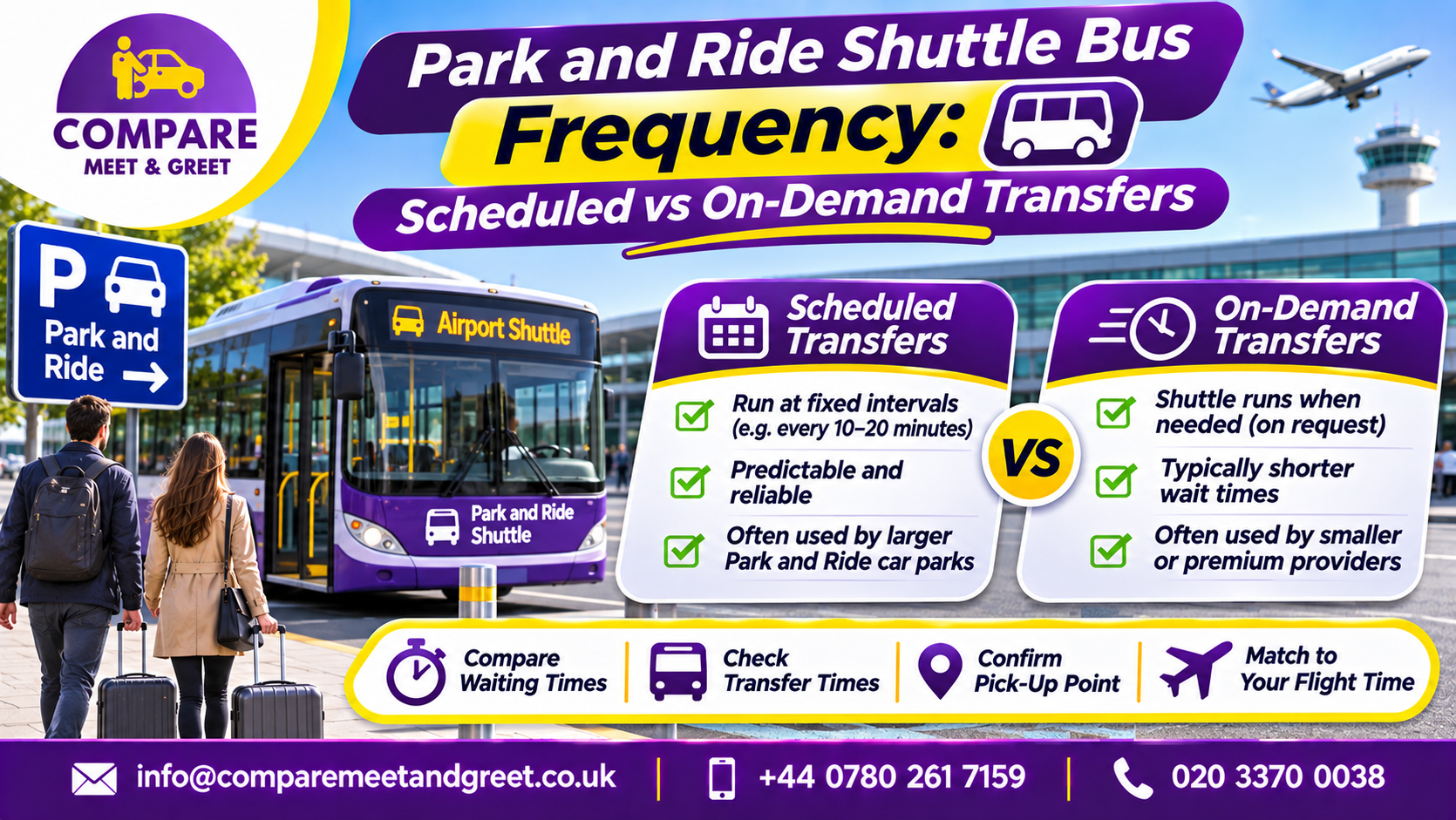
Park and ride shuttle frequency varies between UK airport parking providers. Some operate buses at regular intervals, while others arrange transfers when passengers request collection. A frequent shuttle does not necessarily mean there will be no waiting, and a car park advertised as open 24 hours may have different overnight transfer arrangements. Before booking, check the timetable, first and last regular buses, terminal stops and return collection procedure. Understanding these details helps you plan realistic travel time and avoid unnecessary airport delays.
How Often Do Park and Ride Shuttle Buses Run?
There is no standard shuttle frequency that applies to every airport park and ride service in the UK.
Some parking facilities operate scheduled buses throughout defined hours. Others use smaller vehicles that depart when passengers are ready or after a collection request. Certain services combine regular daytime transfers with a different overnight arrangement.
The frequency depends on the airport, operator, parking location and particular product.
For example, Heathrow Airport states that its official Park & Ride shuttle buses generally operate every 15 minutes between 04:00 and 23:30. Outside those regular hours, customers can request a transfer using the airport’s published procedure.
This information comes from Heathrow’s official Park & Ride guidance. Heathrow
However, that timetable belongs to Heathrow’s official product. It does not establish the frequency of independent parking shuttles serving Heathrow or any other airport.
What Does “Every 15 Minutes” Actually Mean?
A service advertised as departing every 15 minutes generally describes the planned interval between departures.
It does not guarantee that every customer will board immediately or reach the terminal within 15 minutes.
Your total transfer experience may include walking to the correct stop, waiting, boarding, travelling and reaching departures.
For example, if a hypothetical shuttle departs at 04:00, 04:15 and 04:30, someone arriving just after the first departure could face almost a full service interval before the next bus.
There may also be delays caused by traffic, operational changes or boarding requirements.
A quoted shuttle frequency is not the same as a guaranteed waiting time or total journey duration.
When planning a flight, consider the whole process rather than adding only the bus journey time to your driving schedule.
Scheduled Airport Parking Transfers vs On-Demand Shuttles
Understanding the difference between scheduled and on-demand transport is central to choosing a suitable parking service.
Both can work well, but they require different planning.
How Scheduled Shuttle Services Work
A scheduled shuttle operates according to an advertised timetable or regular departure interval.
For example, an operator might state that a bus runs every 15 or 20 minutes during normal service hours.
Customers travel to a designated stop and wait for the next appropriate departure.
Scheduled services offer a useful planning reference because the expected frequency is known.
However, the actual wait depends on when you reach the stop, whether the service is running as expected and whether there is room to board.
You should also establish whether the timetable applies equally to outbound journeys and return collections.
A parking provider might have different schedules for different times of day or terminals.
How On-Demand Airport Shuttles Work
An on-demand airport shuttle is arranged in response to a passenger’s request or arrival rather than relying exclusively on a published departure interval.
Customers may need to call the provider, use an intercom or report to a reception desk.
In some cases, the operator arranges transport once the passenger is ready.
However, “on demand” does not automatically mean immediate departure.
The vehicle could be serving another customer, travelling between the airport and parking facility or waiting for a suitable collection point to become available.
Ask the operator how requests are handled and whether it provides a typical waiting-time estimate.
A Verified UK Airport Example
Heathrow’s official Priority Park & Ride Terminal 5 offers a useful comparison.
According to Heathrow’s Priority Park & Ride Terminal 5 information, the service uses on-demand business-class shuttles during its regular operating hours, rather than following the standard Park & Ride departure model.
Heathrow also publishes a separate out-of-hours request procedure. Heathrow
This demonstrates that even products operated by the same airport may have different shuttle arrangements.
Travellers should check the exact product and terminal rather than assume all services bearing the Park & Ride name operate identically.
Scheduled vs On-Demand Shuttle Comparison
| Feature | Scheduled shuttle | On-demand shuttle |
|---|---|---|
| Departure arrangement | Published timetable or regular interval | Passenger request or operator coordination |
| Passenger action | Go to the stop and wait | May need to call, check in or use an intercom |
| Waiting time | Depends on arrival relative to timetable | Depends on vehicle and operator availability |
| Predictability | Published service interval provides a planning reference | Requires confirmation of the response process |
| Multiple terminal stops | Depends on route | Depends on operator |
| Overnight availability | Check first and last regular services | Check whether requests are accepted overnight |
| Return collection | Wait at designated stop | Follow request or notification instructions |
| Main risk | Missing a departure and waiting for another | Assuming a requested transfer will arrive immediately |
Neither model is inherently superior.
A frequent scheduled shuttle may be convenient for travellers who prefer a clearly defined service.
An on-demand system may suit passengers who prefer a collection arranged around their arrival, provided the response procedure and operating hours are suitable.
The deciding factor is the specific service offered for your journey.
Shuttle Frequency vs Transfer Time: Why the Difference Matters
Airport parking providers may advertise a short shuttle journey, but that figure often represents only the time spent travelling between the car park and terminal.
It does not necessarily include check-in at the parking facility, waiting for the bus or walking to the correct entrance.
The Complete Park and Ride Journey
A typical departure involves several stages:
- Driving to the correct car park entrance.
- Completing any booking or vehicle check-in.
- Parking and unloading luggage.
- Reaching the designated shuttle stop.
- Waiting for the next transfer.
- Travelling to the correct terminal.
- Walking from the drop-off point to the airline’s check-in area.
Not every service requires all these steps in the same way. For example, some use self-parking, while others require customers to hand over their keys at reception.
Nevertheless, each stage that applies to your booking affects your airport arrival time.
Example: Calculating Your Transfer Allowance
Consider a purely hypothetical parking arrangement:
| Journey component | Illustrative allowance |
|---|---|
| Parking and unloading | 10 minutes |
| Walking to the shuttle stop | 5 minutes |
| Waiting for the scheduled bus | Up to 20 minutes |
| Shuttle journey | 15 minutes |
| Walking to departures | 5 minutes |
| Illustrative total | 55 minutes |
These are hypothetical planning figures, not an actual operator’s timetable or a guaranteed journey estimate.
The example shows why a parking provider advertising a 15-minute transfer does not mean you should arrive at the car park just 15 minutes before you need to reach the terminal.
A real itinerary should use the operator’s published instructions, your airline’s recommended check-in time and a margin for reasonably foreseeable delays.
If timing is critical, ask the operator about transfer reliability and what happens if the next vehicle is full.
Overnight Park and Ride Shuttle Services: What Should You Check?
Early departures and late-night returns require particular attention because regular shuttle arrangements may change overnight.
A car park can be open to vehicles while its ordinary shuttle timetable operates during a more limited period.
Conversely, a provider may offer an alternative transfer service outside normal bus hours.
Do not assume either arrangement without checking.
First and Last Regular Shuttles
Before booking, ask for the first and last scheduled departures in both directions.
The last bus leaving the car park for the terminal is a different journey from the last bus returning from the terminal to the car park.
That distinction matters when planning a late-night return.
A traveller landing at 11:00 pm may not be ready to board a return shuttle until considerably later because of immigration, baggage collection or other arrival procedures.
If the regular service ends near that time, confirm the alternative collection process.
Heathrow Overnight Transfers
Heathrow’s official Park & Ride guidance identifies regular buses between 04:00 and 23:30, with a request-based arrangement outside those hours. Heathrow
This is a verified example of a service with different regular and overnight arrangements.
However, Heathrow’s Terminal 4 operations also changed in 2026 following the closure of its multi-storey car park, and its Terminal 4 operational update describes different arrangements for Park & Ride Zone A and the pre-booked zones B–D. Heathrow
Travellers using Terminal 4 should therefore verify their particular parking zone and current transfer instructions instead of relying on a generic Heathrow shuttle description.
Independent operators serving Heathrow may use entirely different schedules.
Planning for a Late Return Flight
If your aircraft is due to land after 10:00 pm, check what happens if arrival procedures carry you beyond the ordinary shuttle timetable.
Confirm whether you need to notify the operator of delays, whether a collection request is required and where to wait.
Do not assume that supplying your flight number means the operator automatically monitors changes or extends your parking booking without charge.
The relevant delayed-return conditions should be stated in the booking terms.
Return Shuttle Collection: What Happens After Landing?
The return journey deserves as much planning as departure.
After landing, you may need to pass through passport control, collect checked luggage and walk to a specific shuttle pick-up point.
That location may differ from the point where the outbound bus dropped you off.
Do You Need to Call the Parking Provider?
Some services provide return buses at regular intervals without requiring a telephone call.
Others ask you to contact the parking operator when you are ready for collection.
With an on-demand service, the provider may need the terminal name, booking reference or designated meeting location.
Follow the exact instructions supplied in your booking confirmation.
If the provider asks you to call after collecting your luggage, do not call immediately on landing unless instructed otherwise.
A vehicle dispatched too early may reach a location before you are ready, potentially creating confusion or extra waiting.
How to Avoid Waiting at the Wrong Bus Stop
Before travelling, identify the correct return collection stop.
Save the directions offline if possible.
Official Heathrow guidance, for example, lists terminal-specific Park & Ride return stops, demonstrating that even one airport can have different pick-up arrangements for different terminals. Heathrow
Check the return instructions again after your flight, particularly if the arrival terminal or airport traffic arrangements have changed.
If the location is unclear, contact the parking provider rather than walking to an assumed stop.
What If the Shuttle Does Not Arrive?
First, confirm you are at the designated stop and within the relevant operating period.
Check the booking confirmation for the operator’s support or collection contact.
If you are using a scheduled service, establish whether the next departure is running.
For on-demand transfers, confirm that your request has been received and ask where to wait.
If the delay becomes significant, retain the relevant communications and follow the provider’s complaints or escalation process.
Avoid arranging alternative transport at the operator’s expense without first understanding the contractual arrangements and attempting to resolve the problem.
What If a Shuttle Is Full, Delayed or Disrupted?
A published shuttle frequency describes the intended service, not necessarily the transport capacity available to every passenger at a particular moment.
A bus may be delayed by road congestion, operational issues or circumstances outside the parking operator’s control.
During busy periods, several groups may arrive at a stop at approximately the same time.
If the next vehicle cannot accommodate everyone waiting, some passengers may need another departure. Whether that occurs depends on the actual operator’s capacity and procedures.
What to Ask About Capacity
If you are travelling in a large group, ask whether the operator has passenger limits or requires advance notification.
Confirm whether every passenger travelling in your car is covered by the transfer service.
Also check whether booking a space in the car park provides any reservation for a particular shuttle departure.
A parking reservation should not automatically be interpreted as a guaranteed seat on a particular bus unless this is expressly stated.
If the service has a busy-period procedure, ask how additional passengers are accommodated.
What About Road Disruption?
Roadworks and airport traffic changes may affect bus routes and stopping locations.
Check the official airport travel information before departure, particularly when travelling during construction or major road changes.
For instance, Heathrow’s 2026 Terminal 4 redevelopment illustrates why previously familiar parking arrangements and shuttle instructions may change. The current Heathrow Terminal 4 update should be consulted for journeys using the affected facilities.
Do not use an old screenshot or a blog article as the sole source for a time-sensitive stop location.
If the operator changes a meeting point, obtain the latest directions through its official communication channel.
Park and Ride Shuttles With Children, Luggage or Mobility Equipment
Shuttle frequency is only one aspect of whether an airport parking transfer suits your passengers.
Families, travellers with bulky luggage and passengers who require assistance should consider the boarding process as well.
Travelling With Children and Luggage
A family with young children may need time to unload suitcases, fold a pushchair and reach the correct stop safely.
A shuttle departing frequently can be helpful, but only if the service accommodates the passengers and equipment involved.
Before booking, establish whether pushchairs need to be folded, where luggage can be stored and whether any particular passenger or baggage restrictions apply.
If travelling with large sporting equipment or unusually bulky bags, contact the operator directly.
Do not assume every parking shuttle is designed for the same luggage capacity.
Wheelchair Accessibility and Assisted Travel
Passengers using wheelchairs or other mobility equipment should confirm whether the actual shuttle vehicle and boarding arrangements meet their needs.
Check whether assistance is required, how it is requested and whether the return transfer uses an equally suitable vehicle.
The UK Civil Aviation Authority’s assisted-travel guidance advises passengers to arrange airport assistance through their airline or travel organiser where possible at least 48 hours before departure. UK Civil Aviation Authority
Parking shuttle arrangements should also be discussed separately with the parking provider.
An airport’s passenger assistance service does not automatically establish that every independently operated parking shuttle has identical accessibility facilities.
Is Meet and Greet a Better Alternative?
For some travellers, meet and greet parking may reduce the need to transfer luggage and passengers onto a separate shuttle.
It normally involves handing the vehicle to an authorised driver at an agreed airport location rather than parking at a facility and boarding a bus.
However, its handover point, walking route, key-handling process and collection arrangements must still be checked.
It should be compared as a different parking product, not presented as another form of Park and Ride.
How to Compare Park and Ride Services by Shuttle Availability
When comparing parking quotations, a cheaper headline price does not automatically mean the overall journey offers better value.
A shuttle service that does not operate when required could make the parking product unsuitable regardless of price.
Compare the Service, Not Just the Quotation
Use the same dates and intended vehicle collection times for each parking option.
Then examine the practical arrangements.
| Comparison factor | Why it matters | Evidence to obtain |
|---|---|---|
| Shuttle model | Scheduled or on-demand affects planning | Operator’s current instructions |
| Regular frequency | Helps estimate possible waiting | Published service interval |
| First and last buses | Critical for early and late flights | Operating timetable |
| Overnight arrangements | May differ from daytime service | Written request procedure |
| Transfer duration | Helps calculate terminal arrival time | Operator’s stated journey estimate |
| Terminal coverage | Not all shuttles necessarily serve every terminal | Confirmed route |
| Return stop | Avoids waiting in the wrong location | Written collection directions |
| Passenger and luggage arrangements | May affect suitability | Provider confirmation |
| Accessibility | Essential for travellers with mobility requirements | Specific shuttle and assistance details |
| Price and conditions | Determines overall suitability | Final quotation and relevant terms |
A service with a shorter bus journey but a longer or less predictable wait may not be more convenient than a slightly longer transfer with a clear timetable.
Likewise, an on-demand service should not be considered faster without evidence about its response process.
A Heathrow Comparison Example
Heathrow offers both official Park & Ride and Priority Park & Ride products, with different transfer models for certain terminals.
Its ordinary Park & Ride service publishes regular shuttle intervals, whereas the official Terminal 5 Priority Park & Ride product describes an on-demand model. Heathrow+1
This is a useful distinction when assessing different services at the same airport.
However, availability, terminal coverage and arrangements can change. Heathrow’s official parking overview currently identifies operational restrictions affecting the Priority Park & Ride facilities for Terminals 2 and 3. Heathrow
Before comparing independent options, use the latest airport and operator instructions for your actual terminal.
For longer trips, you can compare Heathrow Long Stay parking alternatives through Compare Meet and Greet.
The comparison includes different parking arrangements from independent providers, potentially including Park and Ride and meet and greet. Confirm that a shortlisted service actually includes shuttle transfers rather than assuming all long-stay or meet and greet options operate in the same way.
What to Verify With Your Park and Ride Operator Before Paying
Use these questions when checking a service for the first time:
- Is the transfer scheduled, on demand or a combination of both?
- What is the regular departure frequency for my date and terminal?
- What time does the first regular shuttle run?
- What time does the last regular shuttle operate in each direction?
- What should I do if my flight arrives outside normal bus hours?
- Must I call before arrival or after collecting my luggage?
- Where exactly are the outbound and return shuttle stops?
- Does the bus serve my terminal directly or stop elsewhere?
- Are transfers included in my parking quotation?
- Can the transfer accommodate my group, luggage and accessibility requirements?
- What happens if a bus is full or unavailable?
- What are the notification and charging arrangements if my return flight is delayed?
Request written clarification wherever an answer affects whether the product is suitable.
Keep the confirmation and contact details accessible while travelling, including an offline copy if possible.
Frequently Asked Questions About Park and Ride Shuttle Frequency
Does a parking booking guarantee a seat on the next shuttle?
Not automatically. A confirmed parking reservation does not necessarily reserve a seat on a particular shuttle departure. If you are travelling with a large group or require specific transport arrangements, ask the operator whether advance shuttle reservations are necessary or possible.
Can I use the airport parking shuttle without leaving my car at the car park?
That depends on the operator’s conditions. Some transfer services are reserved for customers with qualifying parking bookings, while others may have separate arrangements. Do not assume that a parking shuttle operates as a public bus or that non-customers may board.
Are return shuttle buses always the same as departure buses?
Not necessarily. The vehicle type, route, stopping pattern or collection procedure may differ between departure and return. Check both directions in your booking instructions, particularly if the operator uses a telephone-based return service.
Can I request an earlier shuttle if I am running late?
Some on-demand operators may be able to respond to an earlier request, but this is not guaranteed. Scheduled services may not be able to provide an additional departure. Contact the operator safely and follow its instructions rather than assuming it can rearrange transport to compensate for late arrival.
What if I land at a different terminal from the one I departed from?
Contact the parking operator to confirm the correct return stop and whether it serves your new terminal. A changed arrival terminal may require different instructions or arrangements. Do not assume every shuttle route includes all terminals.
Are airport parking shuttle buses free?
They may be included in the parking price, as with Heathrow’s official Park & Ride product, but the terms vary between operators. Check whether the transfer is included for all passengers, whether any restrictions apply and whether an alternative out-of-hours service involves a separate charge.
Conclusion: Check the Shuttle Timetable Before Booking
Park and ride shuttle frequency is an important part of airport parking convenience, but it should not be considered in isolation.
Scheduled and on-demand services can both work well when their operating arrangements match your journey.
Confirm the first and last regular buses, transfer times, overnight procedures, terminal coverage and return collection instructions. Allow time for parking, waiting, boarding and reaching departures rather than relying on the advertised bus journey alone.
For your next Heathrow trip, compare Heathrow Long Stay parking options, then verify the exact transfer arrangements of any shortlisted Park and Ride service before booking.