
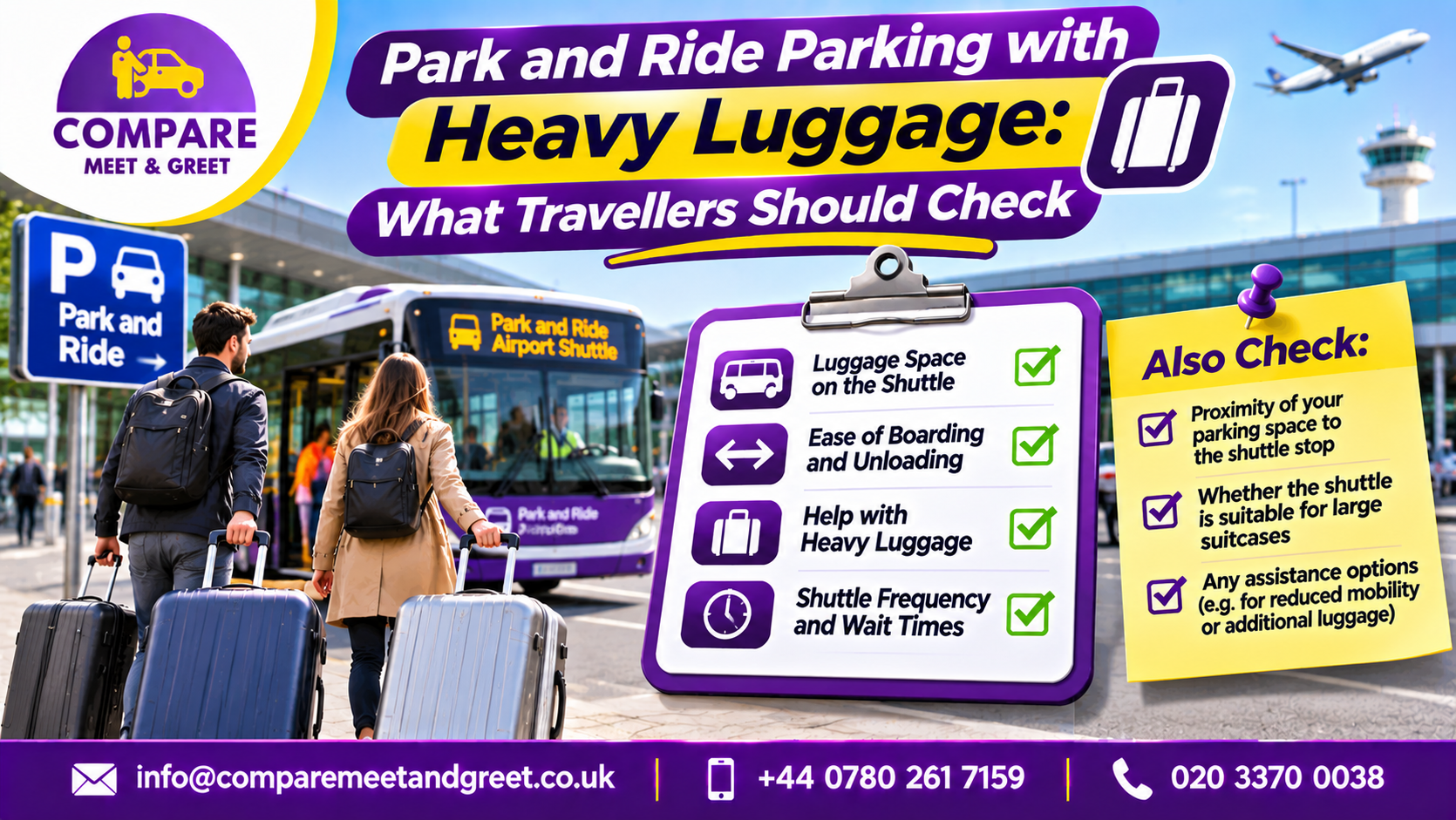
Park and ride airport parking with luggage can be practical, even when travelling with several large suitcases. However, the amount and type of baggage a shuttle can accommodate depend on the airport parking operator, vehicle layout and transfer arrangements. Before booking, check luggage allowances, storage space, loading assistance, shuttle stops and accessibility. Families, solo travellers and passengers carrying pushchairs or mobility equipment may need additional preparation. This guide explains what to confirm and when another parking option might make the journey easier.
Can You Take Heavy Luggage on Park and Ride Airport Shuttles?
Yes, many airport parking shuttles are designed to carry passengers travelling with suitcases and other holiday luggage. However, there is no universal baggage allowance that applies to every UK airport parking provider.
Some official airport services expressly accommodate substantial luggage. For example, Heathrow Airport’s official parking FAQs state that there is no limit on the amount of luggage passengers can bring on its Park & Ride transfer buses. Heathrow also describes luggage storage space on those vehicles.
That is a policy for Heathrow’s official Park & Ride product, not a guarantee for independent parking companies serving Heathrow or other UK airports.
An independent operator might use a different type of shuttle, have limited storage space or require advance notice for unusual items.
What Counts as Heavy or Oversized Luggage?
For parking transfers, the practical concern is usually how easily an item can be moved, loaded and stored safely.
Examples include:
- Large checked suitcases and multiple cabin bags.
- Pushchairs, travel cots and child car seats.
- Golf clubs, skis, snowboards and other sporting equipment.
- Musical instruments or equipment cases.
- Wheelchairs, mobility scooters and other mobility aids.
- Several bags carried by one traveller.
A suitcase accepted by your airline does not automatically meet a particular parking shuttle’s storage requirements.
The airline’s baggage policy governs the flight. The parking operator’s conditions govern the transfer between the car park and terminal.
Check both independently.
Why the Number of Bags Is Not the Only Consideration
Three compact suitcases may be easier to load than a single unusually long equipment case.
Similarly, a traveller carrying one heavy bag may need more assistance than a group sharing responsibility for several smaller cases.
Think about the dimensions, weight, shape and number of items.
Ask whether the shuttle has designated luggage racks, a separate storage compartment or another arrangement.
If the item cannot be safely secured or stored, the provider may need to make alternative arrangements.
Do not assume those arrangements will be available without advance agreement.
Airport Shuttle Luggage Allowance: What Should You Confirm?
The term airport shuttle luggage allowance can refer to several different restrictions.
A provider might limit the number of bags, the dimensions of particular items or the amount of space available per passenger.
Another provider may not publish a numerical allowance but still require baggage to be safely positioned inside the vehicle.
A lack of published restrictions should not be interpreted as unlimited guaranteed capacity.
Ask for the Actual Luggage Policy
Before booking, describe your baggage accurately.
Instead of asking only whether large suitcases are permitted, explain what you will be bringing.
For example:
“We are two adults travelling with four large suitcases, two cabin bags and a folded pushchair. Can your shuttle accommodate everything on our outbound and return transfers?”
This gives the operator enough information to assess the request.
If you have sporting equipment, provide its approximate dimensions and whether it is packed in a rigid case.
Ask whether advance notification is required and whether an additional charge applies.
Obtain written confirmation when accepting the luggage is essential to your booking decision.
Check the Return Journey Too
An operator might confirm that your bags can travel on departure without explaining the return collection procedure.
Ask whether the same luggage arrangements apply in both directions.
This is particularly important if the service uses different vehicles at different times or provides on-demand overnight transfers.
If your return flight arrives late, check whether the scheduled or requested shuttle can still accommodate your baggage.
A return transfer should be suitable for the passengers and items you expect to bring home, not just those you take out.
Shuttle Storage, Loading and Oversized Bags
The shuttle’s luggage layout can affect how easily passengers travel with heavy bags.
Some larger buses have dedicated storage areas. Smaller vehicles may use a different arrangement.
The operator should be able to explain how passengers load and store their belongings.
Who Loads the Suitcases?
Do not assume that a shuttle driver will lift every suitcase.
Some services may provide help with loading, but the availability of assistance depends on staffing, vehicle design and operator policy.
If you cannot safely lift a bag independently, explain this before booking.
Ask whether a member of staff can assist with the specific task or whether the service has suitable low-level luggage access.
This matters particularly for passengers with limited lifting ability or travellers managing several bags alone.
Avoid relying on an informal promise that assistance will probably be available when you arrive.
Can Bags Be Left in the Aisle?
Do not assume luggage can be placed wherever there is space.
Bags should be stored in the location designated by the driver or operator so that they do not obstruct movement, doors or emergency exits.
Heavy cases should be positioned securely rather than balanced where they could move during the journey.
If the storage area is full, ask the driver what alternative arrangement is permitted.
Do not pressure staff to carry items in an unsafe location.
What About Sports Equipment and Unusual Items?
Large sporting equipment deserves particular attention because its dimensions may be more significant than its weight.
A golf bag, ski case or bicycle box could occupy space that would otherwise be used for several normal suitcases.
Contact the operator before booking, identify the item and ask whether it is accepted.
Also check your airline’s own oversized baggage arrangements.
London Gatwick’s official security preparation guidance explains that many oversized items are better handled through the airline’s hold-baggage process, while certain essential or fragile items may require separate security screening.
This guidance concerns airport security and airline baggage arrangements, not parking-shuttle acceptance.
The two stages need separate checks.
Park and Ride Heavy Luggage: How the Transfer Actually Works
When considering park and ride heavy luggage, think through every point where the bags must be moved.
The physical journey usually includes more handling than simply lifting a suitcase out of the car.
From Your Car to the Shuttle
Depending on the service, you may need to park the vehicle yourself or report to a reception area.
After unloading, the bags must be moved to the shuttle stop.
The distance between the parking bay, reception and stop may matter if the luggage is heavy.
Ask whether baggage trolleys are available, whether the route is suitable for wheeled suitcases and whether you must cross active vehicle areas.
Not every off-site facility has the same pedestrian layout.
Boarding the Shuttle
At the bus, you may need to lift items into a storage area or follow the driver’s loading instructions.
A high step, limited luggage compartment or busy boarding process can make this more demanding.
If you require assistance, establish the arrangement beforehand.
When travelling with companions, one person can supervise children and essential hand luggage while another manages the larger cases.
Solo travellers should consider whether they can safely control all their items during boarding.
From Shuttle to Terminal
Arriving at the airport does not end the luggage transfer.
You still need to unload everything, check that no bags remain aboard and reach the terminal entrance.
The bus stop may not be immediately beside your airline’s check-in desks.
Ask where the shuttle stops and whether the onward route involves a substantial walk.
For a passenger with several large suitcases, a short bus journey followed by a difficult walk may be less convenient than a different parking arrangement.
Scheduled Shuttles, Capacity and Luggage Waiting Times
A frequent shuttle service can reduce waiting, but it does not guarantee that every bag will fit on the next departure.
The operator’s vehicle type, passenger demand and loading arrangements matter.
What If the Bus Is Full?
If the next shuttle lacks sufficient room for passengers and luggage, you may need to follow the operator’s alternative boarding instructions.
Do not assume that a confirmed parking booking reserves a specific luggage space on a particular bus.
Ask whether large groups or oversized equipment require advance notification.
For an early flight, allow for the possibility that boarding may take longer when many travellers arrive together.
Scheduled vs On-Demand Transfers
Scheduled services operate according to a published timetable or regular interval.
On-demand transfers may require passengers to call or check in before a vehicle is arranged.
Neither approach automatically provides greater luggage capacity.
If the operator uses smaller on-demand vehicles, ask whether it needs to arrange transport specifically for your group or equipment.
Check the outbound and return procedures separately.
Allow Time for Loading
A transfer advertised as a short journey usually describes the driving time between the parking facility and terminal.
It may not include parking, unloading, moving bags to the stop, waiting, boarding and walking into departures.
Use your airline’s recommended terminal arrival time, then work backwards through these stages.
The more luggage you have to manage, the more important it is to avoid planning around the shuttle driving time alone.
Travelling With Children, Pushchairs and Family Luggage
Families often carry more items than the number of passengers initially suggests.
Alongside suitcases, there may be changing bags, a pushchair, car seats, a travel cot and children’s hand luggage.
Park and Ride can still be suitable, but the transfer needs to work for both the equipment and the people travelling.
Must Pushchairs Be Folded?
That depends on the operator’s vehicle and boarding policy.
Some shuttles may require a pushchair to be folded and stored with luggage. Other vehicles may have different arrangements, particularly where accessible boarding space is provided.
Ask whether your specific pushchair can remain assembled, whether folding is compulsory and how it should be stored.
If you use a large double pushchair or a model that does not fold compactly, provide its dimensions.
Do not assume that an airport parking shuttle follows the same rules as a public bus.
Travelling Alone With Children
A solo adult may need to supervise children while moving luggage and boarding the shuttle.
This is often a more important consideration than the advertised parking price.
Before choosing the service, assess whether you can manage the actual equipment without losing safe supervision of the children.
Consider reducing the number of separate bags, using luggage that rolls easily and keeping essential items in one accessible backpack.
If the physical transfer is likely to be difficult, compare terminal parking or meet and greet instead.
A service that suits a family with two adults may not suit someone managing a baby, pushchair and several heavy cases alone.
Can You Drop Passengers at the Terminal First?
In some circumstances, one adult could take the family and luggage to an authorised airport drop-off location before driving alone to the Park and Ride facility.
However, this creates two separate journeys and may incur an airport terminal access charge.
It also leaves the person at the terminal responsible for the group and baggage.
Check the airport’s permitted stopping locations, payment rules and suitability of this arrangement before considering it.
Never stop in a restricted area or assume that a Park and Ride booking includes a separate terminal drop-off.
Wheelchairs, Mobility Aids and Accessible Shuttle Transfers
Passengers using mobility equipment need to assess the transfer more carefully than someone travelling with standard suitcases.
An airport parking shuttle with space for luggage is not automatically suitable for every wheelchair or mobility scooter.
Check the actual boarding arrangements, equipment compatibility and assistance available.
What Do Official Airports Provide?
London Gatwick’s official parking FAQs state that its Long Stay shuttle buses are accessible for wheelchair and mobility scooter users.
Gatwick also identifies assistance facilities associated with its car parks and terminal shuttle stops.
These statements apply to Gatwick’s official facilities, not every independent Park and Ride company serving the airport.
The UK Civil Aviation Authority’s assistance guidance explains that qualifying airport assistance can include support between designated car parks, bus stops or drop-off points and the terminal.
Travellers are encouraged to request assistance through their airline or travel organiser when booking, or at least 48 hours before departure where possible.
The parking operator and airport assistance team may have different responsibilities.
Questions About Mobility Equipment
Ask whether the shuttle can accommodate the particular wheelchair or scooter, including its dimensions and weight.
Confirm the boarding method, whether a ramp or lift is available and whether the passenger can remain in the equipment during the journey.
If assistance is needed to load a separate mobility aid, ask what the operator’s staff are trained and permitted to do.
Airline arrangements for transporting mobility equipment are another separate consideration. The CAA’s guidance on mobility and medical equipment provides further advice.
Do not book based solely on a general description such as “accessible parking”. Confirm the specific requirements before paying.
Is Meet and Greet Easier Than Park and Ride With Large Suitcases?
Meet and greet may be a useful alternative when you would prefer not to move heavy luggage between your car and a separate shuttle.
With a typical meet and greet service, the operator accepts your vehicle at an agreed airport location. You unload your bags and continue towards the terminal rather than travelling from a remote parking facility by shuttle.
However, the vehicle handover point may still be some distance from departures, and the operator’s collection procedure can involve waiting or walking.
For travellers using Gatwick, explore Gatwick Meet and Greet parking alternatives and check the actual handover arrangements before choosing.
The page compares meet and greet options, although it also discusses other parking categories. A meet and greet booking should not be mistaken for a Park and Ride shuttle service.
Heavy-Luggage Parking Comparison
| Traveller requirement | Park and Ride | Meet and Greet | Terminal self-parking |
|---|---|---|---|
| Several large suitcases | Requires car-to-shuttle-to-terminal handling | Usually unload at agreed handover point | Usually unload near the car park’s terminal route |
| Large pushchair | Shuttle folding and storage rules may apply | No separate shuttle in the usual process | Check walking route and lifts |
| Solo traveller with heavy bags | Additional loading stages | May reduce transfers | Avoids shuttle if terminal is walkable |
| Mobility equipment | Confirm vehicle and boarding access | Confirm handover and step-free route | Confirm accessible bays and route |
| Vehicle keys | Depends on product | Usually surrendered | Normally retained |
| Main time consideration | Parking, waiting and shuttle | Handover and collection coordination | Parking and walking |
| Main booking check | Baggage capacity and transfer availability | Handover location and vehicle conditions | Terminal access and parking suitability |
This comparison describes typical service models, not verified facilities or guaranteed assistance from any individual provider.
The better option is the one that safely accommodates your passengers and equipment at a total price you are comfortable paying.
Packing and Arrival Checklist for Airport Parking With Suitcases
Good preparation can reduce unnecessary handling and confusion during the transfer.
Before leaving home, count your bags and confirm that each item can be carried or rolled safely.
Keep passports, medication, tickets, vehicle keys where appropriate and essential supplies in a bag that stays with you.
Avoid packing crucial items into luggage that will be difficult to reach once the shuttle is loaded.
Before Booking
Check the shuttle’s luggage policy and confirm whether large or unusual equipment is accepted.
Ask about the number of passengers, operating hours and return arrangements.
If you require loading assistance, describe exactly what help you need.
Check that the total price includes the necessary transfer and any additional arrangement agreed with the operator.
Before Driving to the Car Park
Make sure you have the correct parking address and booking confirmation.
Arrange the luggage so that it can be unloaded without opening several bags.
If travelling with children, decide who will supervise them and who will handle the heavier cases.
For an early departure, confirm that the shuttle will operate at your expected arrival time.
At the Shuttle Stop
Keep bags together without obstructing the pedestrian route.
Follow staff instructions for boarding and luggage storage.
Do not leave children unattended while loading.
Count your bags before boarding and again when leaving the shuttle.
After returning from your holiday, repeat these checks before leaving the airport collection stop and before driving away from the parking facility.
Questions to Ask Your Parking Operator Before Paying
Use the following decision checklist to establish whether the transfer can handle your luggage and travel needs.
| Question | Why it matters | What to obtain |
|---|---|---|
| Is there a luggage allowance? | Establishes permitted baggage quantity | Written luggage policy |
| Are large suitcases accepted? | Identifies any size restrictions | Confirmation for your bags |
| Can I bring sports equipment? | Unusual dimensions may need approval | Specific acceptance |
| Is loading assistance available? | Important if you cannot lift luggage | Confirmed staff support |
| Where is luggage stored? | Helps assess safe handling | Vehicle storage description |
| Must a pushchair be folded? | Affects families travelling with children | Pushchair policy |
| Can the shuttle accommodate my mobility equipment? | Essential for accessible travel | Equipment-specific confirmation |
| Where is the shuttle stop? | Determines carrying and walking distance | Actual directions |
| How often does it run? | Helps plan time with heavy bags | Current timetable or request process |
| Are return transfers identical? | Prevents problems after landing | Return collection instructions |
| What if my flight is delayed? | May affect transfer and parking charges | Notification and extension terms |
| Are any special arrangements charged separately? | Avoids unexpected costs | Final quotation |
If the operator cannot confirm an essential requirement, consider an alternative service rather than assuming the issue can be resolved at the shuttle stop.
Frequently Asked Questions About Park and Ride Airport Parking Luggage
Can I take more luggage than passengers on an airport parking shuttle?
It depends on the operator. Heathrow’s official Park & Ride service states that it has no luggage quantity limit, but this does not apply universally. Another provider may impose restrictions or require advance notice. Declare the actual number and type of bags if there is any doubt.
Are airport parking shuttle drivers required to lift heavy suitcases?
Do not assume they will provide lifting assistance. Responsibilities depend on the provider, staffing and safe-handling arrangements. If you cannot load a case independently, contact the operator beforehand and obtain confirmation of what help is available.
Can a bicycle box travel on a Park and Ride bus?
Possibly, but its dimensions may create storage difficulties. Contact the parking operator with the packed bicycle’s approximate size and confirm acceptance in writing. Separately check your airline’s sporting equipment and oversized baggage requirements.
What if I leave a suitcase on the shuttle?
Contact the parking operator promptly using the details in your booking confirmation. Provide a description of the item, relevant journey time and the shuttle stop. Follow its lost-property procedure, but do not assume that the operator can immediately locate or return the bag.
Can I use a luggage trolley between the car park and shuttle?
That depends on the facility. Some car parks may provide trolleys, while others do not. Confirm their availability and where they can be used. Do not assume a trolley may be taken onto the shuttle or left at the terminal without authorisation.
Will a parking shuttle carry a car seat or child booster seat?
A packed car seat may be accepted as luggage, but storage and transport conditions vary. If you want a child to use a restraint during the shuttle journey, ask about the actual vehicle type, seating and applicable rules. Do not assume the shuttle provides suitable child restraints.
Conclusion: Choose a Transfer That Works for Your Luggage
Park and ride airport parking with luggage can be straightforward when the shuttle has suitable capacity and the loading arrangements fit your needs.
Before booking, confirm the baggage policy, storage space, help with heavy items, pushchair requirements and return transfer procedure. Travellers carrying mobility equipment should also verify the specific accessibility arrangements.
If you would rather avoid moving heavy bags onto a separate shuttle, compare Gatwick Meet and Greet parking options as a different parking arrangement.
Choose the service that suits your passengers, equipment and timetable—not simply the lowest advertised parking price.