
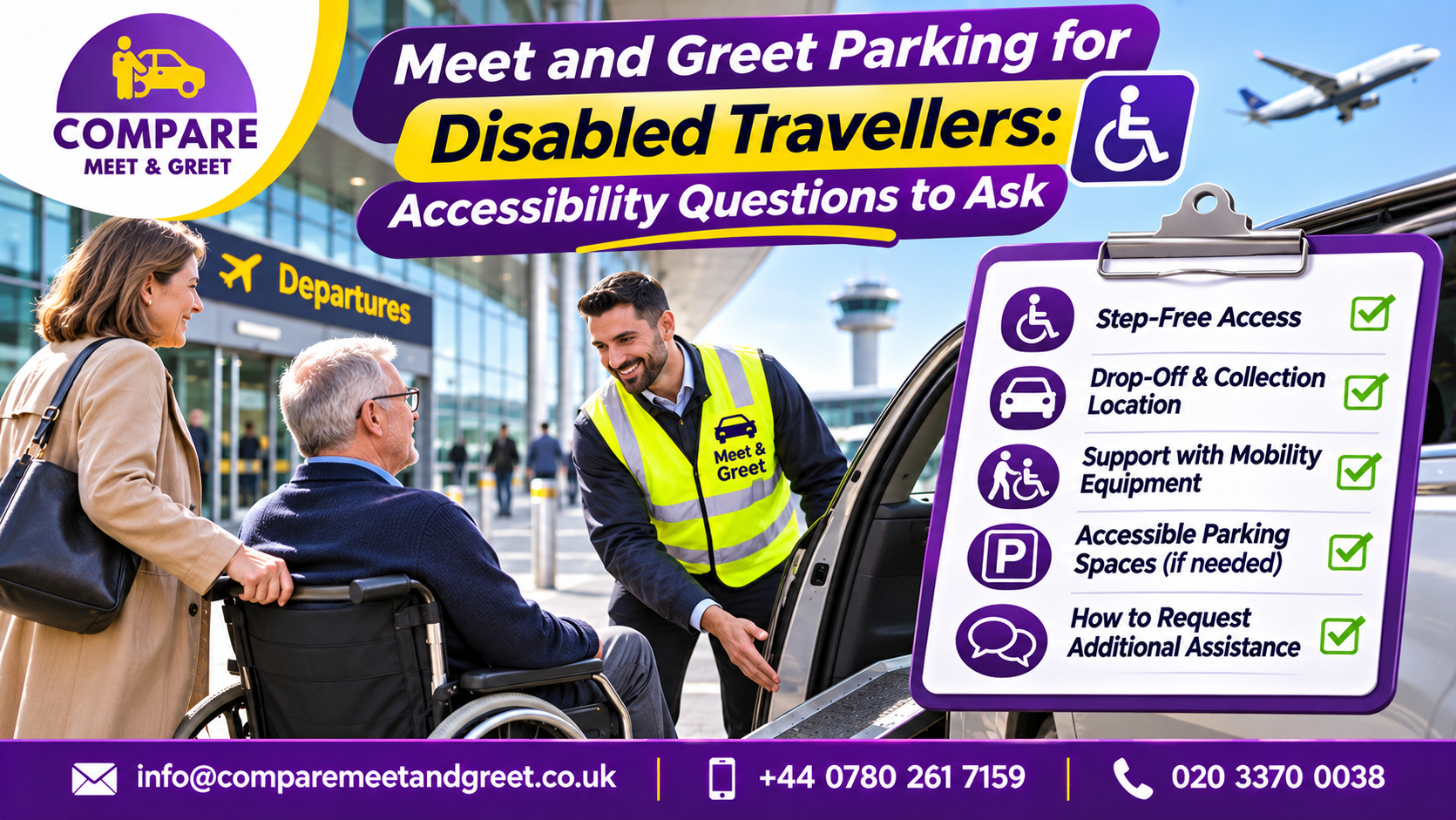
Accessible meet and greet airport parking can make travelling easier for some disabled passengers by reducing the need to park at a distant facility and use a shuttle bus. However, accessibility depends on the actual vehicle handover point, walking or wheeling route, assistance arrangements and individual requirements. Not every meet and greet operator offers the same facilities. Before booking, confirm where you will leave your vehicle, how you will reach the terminal and whether the parking service can accommodate your specific needs.
Is Meet and Greet Parking Suitable for Disabled Travellers?
Meet and greet parking can be a practical option for disabled travellers, but it should not automatically be considered the most accessible type of airport parking.
The service generally involves driving to an agreed airport location, handing your vehicle to an authorised representative and continuing towards departures. The operator then parks the vehicle according to its arrangements.
After your return flight, the vehicle is brought to an agreed collection point or made available through the operator’s specified collection procedure.
For some passengers, this can reduce the physical effort involved in parking and reaching the terminal.
For example, a wheelchair user may prefer avoiding a shuttle transfer if the meet and greet handover point provides a suitable step-free route into departures.
A passenger who finds prolonged walking difficult might prefer a meeting location close to an airport assistance point.
Someone travelling with mobility equipment may value being able to unload at a designated location rather than transferring equipment between a vehicle and a shuttle.
However, these advantages depend on the specific service.
Why Accessibility Cannot Be Assumed
A meet and greet booking may use a designated level of a multi-storey car park rather than a stopping area directly outside the terminal entrance.
The route could involve lifts, pedestrian crossings, ramps or a distance that is challenging for some passengers.
The availability of assistance with unloading or transferring between a vehicle and wheelchair may also differ.
A provider describing its service as “convenient” or “close to the terminal” does not necessarily confirm that it meets a passenger’s individual accessibility needs.
The most important question is not simply whether meet and greet parking is accessible, but whether the complete journey from your vehicle to the terminal is suitable for you.
If you are unable to establish this before booking, request specific information from the operator or consider another parking arrangement.
Understanding Accessible Meet and Greet Airport Parking
An accessible parking arrangement should be evaluated as a connected journey rather than a single handover point.
The relevant stages are arriving at the airport, positioning the vehicle safely, unloading passengers and equipment, completing the handover and reaching the appropriate terminal assistance point.
The same assessment is needed in reverse after the return flight.
Accessibility Needs Can Vary Considerably
Different travellers may require different arrangements.
A manual wheelchair user may need a safe unloading area with sufficient space beside the vehicle.
A powered wheelchair user may need a suitable surface, accessible route and enough room to manoeuvre.
A person with limited walking endurance may prioritise distance and access to seating.
Someone with visual or hearing impairments may need clear directions, suitable communication methods or assistance identifying the correct representative.
Passengers with non-visible disabilities may benefit from predictable instructions, a quieter handover process or additional time.
The UK Civil Aviation Authority’s guidance on accessibility rights recognises that assistance requirements can include physical disabilities, reduced mobility and non-visible disabilities.
The parking operator still needs to confirm what it can provide within its own service.
An Accessible Airport Does Not Guarantee an Accessible Parking Product
An airport may offer extensive passenger assistance facilities while a particular independent parking operator uses a handover location that is unsuitable for your requirements.
Conversely, a self-parking facility with a suitable accessible bay and direct terminal route may work better than meet and greet for some travellers.
Consider the complete route and the individual operator’s procedures before deciding.
Accessible Terminal Handover: Questions to Ask Before Booking
The vehicle handover is often the most important accessibility consideration.
A suitable meeting point needs to work for the vehicle, passengers, luggage and mobility equipment involved.
1. Where Exactly Will the Vehicle Handover Take Place?
Ask the provider for the precise location rather than accepting a general description such as “terminal drop-off”.
Useful information includes the car park name, entrance, level, designated bay and walking route to departures.
At London Gatwick, for example, official parking products include different terminal car parks and valet arrangements.
The airport provides detailed Blue Badge parking information, including accessible spaces, assistance points and links to AccessAble access guides.
Those official facilities should not be assumed to be the same locations used by every independent meet and greet operator.
If a provider uses a third-party handover area, request information about that specific location.
2. Is There Enough Space for a Safe Transfer?
A passenger who transfers between a vehicle and wheelchair may require space alongside the car.
A vehicle with a ramp or lift may require additional clearance at the side or rear.
Ask whether the handover location can accommodate the required positioning.
For a wheelchair-accessible vehicle, give the operator relevant information about the ramp or lift configuration.
Do not assume that a standard car parking bay is suitable for every adapted vehicle.
If you need a particular vehicle orientation or unloading space, obtain agreement before arrival.
The operator should also explain what happens if the designated area is unavailable when you reach the airport.
3. Is the Route to Departures Step-Free?
A short distance is not necessarily an accessible distance.
Check whether the route includes steps, steep gradients, narrow passages, unsuitable surfaces or lifts that are required to reach the terminal.
Ask whether the route is covered, whether there are suitable pedestrian crossings and how far it is to an assistance point.
Published airport access guides can help, but make sure the guide relates to the actual handover location.
For instance, Gatwick provides detailed parking access information developed with AccessAble through its official Blue Badge parking pages.
Where available, review the relevant route information and clarify anything that remains uncertain.
4. Can the Operator Assist With Unloading?
Do not assume the parking driver is trained or authorised to provide personal assistance.
Some travellers may only need time to unload equipment independently. Others may require practical help with luggage or transferring equipment out of the vehicle.
Ask what the operator’s staff can and cannot do.
If physical assistance is required, explain the task specifically.
For example, ask whether staff can help remove a folded wheelchair from the boot rather than making a general request for “wheelchair assistance”.
If the operator cannot provide the support required, establish whether airport assistance personnel can meet you at a designated point.
Airport Special Assistance vs Parking Operator Assistance
One of the most important distinctions is between airport passenger assistance and the service provided by a parking company.
They are connected parts of the journey, but they are not necessarily provided by the same organisation.
What Does Airport Passenger Assistance Cover?
The CAA explains that qualifying disabled passengers and passengers with reduced mobility have rights to assistance when travelling by air.
For eligible journeys, assistance is provided without an additional charge.
Depending on the passenger’s needs, this may include help travelling from a designated airport arrival point to the terminal, moving through the airport, boarding the aircraft and reaching an appropriate exit point after arrival.
The CAA’s How to Access Help and Support guidance explains that assistance can include transfers from car parks, bus stops or drop-off points.
Passengers are encouraged to request assistance through their airline, travel agent or tour operator when booking, or at least 48 hours before departure where possible. UK Civil Aviation Authority
Advance notice helps the relevant organisations prepare, although passengers who have not booked assistance in advance can still request help.
What Is the Parking Operator Responsible For?
The parking operator provides the parking service described in its booking terms.
For meet and greet, this ordinarily includes receiving the vehicle and arranging its parking and return.
It does not automatically include assistance through airport security, wheelchair provision, personal care or transport to the aircraft.
Similarly, airport special assistance does not automatically mean an independent parking operator has agreed to assist with operating a vehicle ramp or handling specialised equipment.
How to Coordinate Both Services
Contact your airline or travel organiser to request airport assistance.
Separately, contact the parking provider to establish the exact handover location and available arrangements.
Then ask the airport assistance team whether support can begin at that location or whether you need to reach another designated assistance point.
If the two services use different meeting locations, resolve this before travelling.
Written confirmation from both organisations can make the departure process clearer.
Gatwick Airport: A Practical Example of Accessible Parking Arrangements
London Gatwick provides useful examples of how different official parking products can meet different passenger requirements.
Its Blue Badge parking guidance confirms that official airport car parks have designated accessible spaces, with assistance available through help points.
The airport also identifies its official Valet Parking service as an option worth considering for passengers with reduced mobility.
For Long Stay parking, Gatwick describes accessible shuttle buses serving its parking facilities.
These are specific official airport arrangements and should not be represented as guaranteed features of independent parking companies.
Gatwick North and South Terminals
Gatwick has separate North and South Terminal parking facilities.
A traveller requiring accessible vehicle handover should confirm which terminal the service supports and where the actual meeting point is located.
The airport’s Assisted Travel guidance explains assistance arrangements and identifies car parks and terminal areas where passengers can request support.
Do not assume that an operator serving both terminals provides identical handover arrangements at each.
Comparing Independent Gatwick Meet and Greet Providers
A comparison website can help identify potential parking options, but individual accessibility requirements still need to be verified with the operating company.
For example, if you require rear-ramp access, establish whether the particular handover location can accommodate your vehicle and equipment.
If you use a powered wheelchair, clarify the step-free route between handover and the terminal assistance point.
If you require a quiet, clearly coordinated meeting, confirm the contact procedure and the operator’s ability to accommodate it.
The existence of a booking option does not prove that it is appropriate for every disabled traveller.
Vehicle Adaptations and Mobility Equipment: What Must Be Checked?
Adapted vehicles introduce questions that may not arise with a standard car.
These can affect whether a parking operator can accept the vehicle, safely move it and return it in a suitable condition.
Wheelchair-Accessible Vehicles
A wheelchair-accessible vehicle may have a lowered floor, side or rear access ramp, lift or other specialist equipment.
Confirm the vehicle’s height, width and length against the facility’s restrictions.
If the operator will drive the vehicle, explain any adaptations affecting its controls or operation.
Do not assume that a parking representative is trained to use unfamiliar driving adaptations.
If the operator cannot confirm it can safely accept the vehicle, consider a self-parking option where the passenger or authorised driver retains control.
Hand Controls and Other Driving Adaptations
Some vehicles use hand controls or other modifications to accommodate the driver’s needs.
If a meet and greet operator intends to move the vehicle, it is important to establish whether an authorised driver can operate it safely.
Ask whether staff require any instructions or whether particular adaptations affect acceptance.
Do not surrender the keys until the operator has confirmed the agreed arrangements.
A service that is convenient for an unmodified vehicle may not be suitable for every adapted car.
Wheelchairs and Mobility Scooters
Mobility equipment may be essential from the moment you leave the vehicle until you board the aircraft.
Make sure you understand how the equipment will be unloaded and whether you can continue using it through the terminal.
If you are travelling with a powered wheelchair or mobility scooter, provide relevant information to the airline in advance.
The CAA’s guidance on travelling with mobility and medical equipment explains the importance of providing the airline with details such as the equipment’s dimensions, weight and battery type. UK Civil Aviation Authority
Airline requirements for transporting mobility equipment are separate from the parking operator’s vehicle handover arrangements.
Meet and Greet vs Other Disabled Airport Parking Options
Meet and greet may reduce the need to travel between a distant car park and departures, but other products may offer advantages.
The most suitable option depends on how the passenger reaches the terminal, rather than the parking category alone.
| Parking option | Potential advantage | Accessibility question to verify |
|---|---|---|
| Meet and Greet | Vehicle handed over at an agreed airport location | Is the handover area suitable for unloading and reaching assistance? |
| Terminal or Short Stay parking | May provide a walkable route to departures | Are suitable bays, lifts and step-free routes available? |
| Long Stay self-parking | Customer may retain their keys | Are accessible bays and transfers available? |
| Park and Ride | May provide alternative pricing and parking arrangements | Can the shuttle accommodate the passenger and equipment? |
| Official Valet Parking | Operator handles vehicle parking | Is the reception and handover location suitable for the passenger’s requirements? |
These are potential benefits, not assurances that any specific operator can meet an individual requirement.
When Might Terminal Self-Parking Be Better?
A passenger who prefers to park an adapted vehicle personally may find terminal self-parking more suitable.
They can retain the keys and may avoid having another person operate unfamiliar adaptations.
However, check parking bay dimensions, the route to the terminal and whether appropriate assistance is available.
When Might Park and Ride Work?
Some official airport park and ride facilities provide accessible shuttles and parking bays.
For example, Gatwick states that its official Long Stay transfer buses can accommodate wheelchairs and mobility scooters. London Gatwick Airport
That does not establish the accessibility of every independent shuttle.
Ask whether your particular equipment can be accommodated, how boarding works and whether assistance is provided.
A lower parking price should not outweigh a requirement that the service cannot meet.
Questions to Ask Before Confirming an Accessible Parking Booking
The following checklist helps turn a general accessibility enquiry into specific questions an operator can answer.
| Subject | Question for the operator | Evidence to request |
|---|---|---|
| Meeting point | Where exactly will I hand over my vehicle? | Written location and directions |
| Step-free access | Is the complete route to departures step-free? | Route description or official access guide |
| Vehicle unloading | Is there room for my wheelchair, ramp or lift? | Confirmation of suitable positioning |
| Staff assistance | What help can your staff provide? | Clear description of available support |
| Vehicle adaptations | Can your drivers safely handle my adapted vehicle? | Written acceptance |
| Mobility equipment | Can I unload and retain the equipment I need? | Agreed handover procedure |
| Airport assistance | Where is the nearest designated assistance point? | Confirmed point and route |
| Return collection | Will the return meeting point be equally suitable? | Written collection instructions |
| Flight changes | What happens if I return later than booked? | Delay and amendment policy |
| Charges | Are all necessary access and service charges included? | Full quotation and terms |
For accessibility-critical arrangements, a vague response such as “we are disability friendly” is not enough.
Ask the provider to explain how the service will work in your particular circumstances.
Planning Your Departure and Return Journey
Accessible parking arrangements should work in both directions.
A suitable departure handover is of limited benefit if the return collection point requires a route the passenger cannot use.
Before Leaving Home
Recheck the terminal, meeting location and parking operator’s instructions.
Save the relevant contact details and confirm any special arrangements made with the airport assistance team.
If another person is driving, ensure they understand the vehicle handover and unloading procedure.
Allow sufficient time for the agreed process rather than assuming that meet and greet always involves an immediate handover.
At the Handover Location
Follow the designated approach route and contact the operator if required.
Position the vehicle only where authorised and safe to unload.
Complete the agreed transfer of passengers and equipment before the operator moves the car.
If the arrangements differ from what was confirmed and you cannot unload safely, contact the provider rather than attempting an unsuitable transfer.
After Your Return Flight
Follow the airline and airport’s assisted-travel procedure, including assistance through arrivals where required.
Contact the parking provider according to its collection instructions.
Confirm that the car will be returned to an accessible location and that the relevant equipment can be loaded safely.
If your flight is delayed or diverted, inform the operator through its specified process and ask whether the collection arrangements need to change.
What If the Agreed Accessibility Arrangements Are Not Available?
Occasionally, a meeting point, lift, route or staffing arrangement may differ from what was expected.
The safest response is to explain the specific barrier and request an appropriate alternative.
For a problem with airport passenger assistance, notify the relevant airport or airline staff so they can attempt to resolve it.
The CAA’s guidance on reporting assisted-travel problems explains how passengers can raise concerns and pursue complaints when necessary. UK Civil Aviation Authority
For an issue with an independent parking service, contact the company responsible for the reservation or physical vehicle handover, as appropriate.
Keep relevant booking confirmations, written accessibility requests and any responses.
Do not assume that another driver or airport employee can provide specialised assistance without first confirming the arrangement.
If an essential requirement cannot be accommodated, prioritise a safe alternative rather than proceeding with an unsuitable handover.
Frequently Asked Questions About Accessible Meet and Greet Parking
Do I need a Blue Badge to request accessible meet and greet parking?
Not necessarily. A Blue Badge is relevant to particular parking privileges and arrangements, but disability-related travel assistance is not limited to Blue Badge holders. Ask the operator what information it needs and whether the service can accommodate your requirements. Check specific eligibility rules where a Blue Badge concession is advertised.
Can someone else drive my adapted car to the meet and greet handover?
Potentially, provided the driver is legally authorised and appropriately insured, and the operator accepts the arrangement. Check whether the parking company needs the driver’s details or any additional information about the vehicle. Also confirm who is permitted to move it after handover.
Can I request airport assistance if I have a non-visible disability?
Yes. Airport assisted travel is not limited to wheelchair users. The CAA recognises that passengers with non-visible disabilities may need help navigating the airport. Explain the assistance required through your airline or travel organiser, preferably in advance, and separately discuss any relevant parking handover needs.
Does a meet and greet driver have to help me transfer into a wheelchair?
Do not assume that personal transfer assistance is included. The driver’s responsibilities depend on the parking service and the operator’s arrangements. Ask specifically whether trained assistance is available for the task you need. Coordinate with the airport assistance team where appropriate.
Can I leave a mobility aid inside my parked car while travelling?
That depends on whether you need the equipment during your airport and flight journey. If leaving an item in the vehicle, check that it can be safely stored and whether the parking operator has restrictions on belongings. Do not leave equipment you need for boarding or arrival without confirming an alternative.
Will accessible meet and greet parking cost more?
There is no universal surcharge or pricing rule covering all meet and greet providers. Prices depend on the parking product and applicable terms. Request the full quotation and ask whether any specific arrangement affects the charge. Airport assisted travel provided under applicable passenger rights is distinct from the separately purchased parking service.
Conclusion: Choose Parking That Meets Your Actual Accessibility Needs
Accessible meet and greet airport parking can be a helpful option for disabled travellers, particularly when it reduces transfers and provides a suitable route into the terminal.
However, the quality of the arrangement depends on the individual operator, handover location, vehicle requirements and coordination with airport assistance.
Before booking, confirm the complete departure and return process in writing.
If you are travelling from Gatwick, explore Gatwick Meet and Greet parking alternatives with Compare Meet and Greet. Use the comparison to identify potential services, then contact the chosen operator to confirm that its actual arrangements meet your accessibility requirements before paying.