
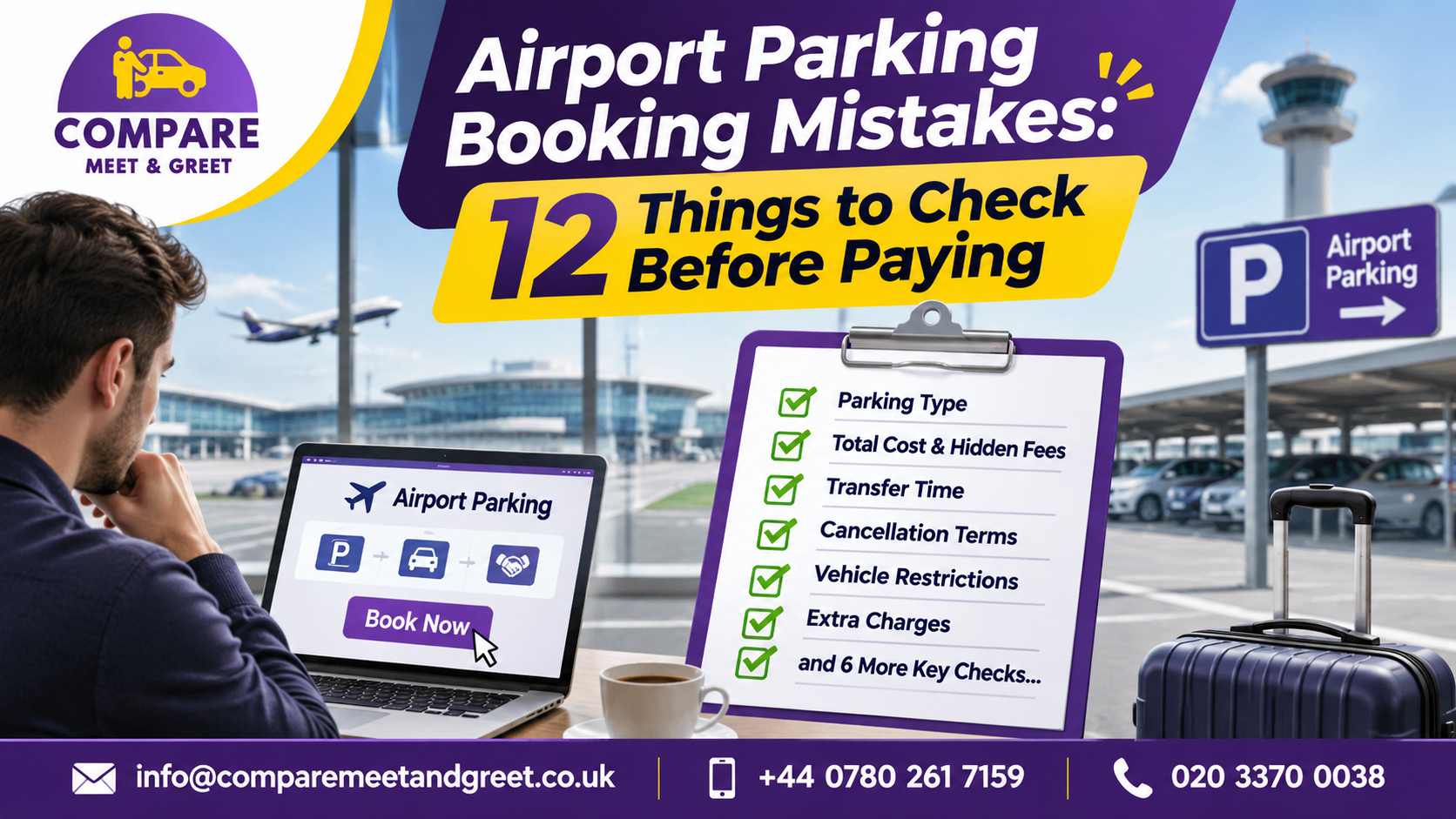
The most common airport parking booking mistakes include choosing the wrong terminal, overlooking transfer times, ignoring additional charges and booking a service that does not suit your vehicle or flight schedule. These errors can create unexpected costs, delays and unnecessary stress before or after your holiday. To avoid them, compare the full parking price, check the operator’s conditions, confirm arrival instructions and understand what happens if your flight changes. This guide explains 12 important checks every UK traveller should make before paying.
What Are the Most Common Airport Parking Booking Mistakes?
Booking airport parking can appear straightforward. You enter your travel dates, choose a parking option and complete your payment. However, two services advertised for the same airport can operate quite differently.
One may require you to drive to an off-site car park and take a shuttle to the terminal. Another may involve meeting a driver at a designated airport handover location. A third may provide self-parking within an airport-operated facility.
The problem is that travellers sometimes compare these services using the advertised price alone, without examining what that price includes.
Common mistakes fall into five categories:
- Booking details: Incorrect dates, times, terminals or vehicle registration numbers.
- Service suitability: Choosing an unsuitable parking product or overlooking transfer arrangements.
- Unexpected costs: Failing to check access fees, additional days, amendments or other possible charges.
- Operator conditions: Not understanding cancellation policies, vehicle restrictions or key handling.
- Travel disruption: Assuming delayed flights, late arrivals and changed itineraries will be accommodated without additional arrangements.
These mistakes can affect travellers using Heathrow, Gatwick, Manchester, Stansted, Luton, Bristol and other UK airports.
Importantly, not every parking operator applies the same conditions. A restriction affecting one service should not automatically be assumed to apply to another.
The best airport parking advice for UK travellers is to assess each offer against their actual journey rather than choosing solely by price or convenience claims.
12 Airport Parking Booking Mistakes and How to Avoid Them
1. Choosing the Cheapest Advertised Price Without Checking the Total Cost
A low headline price can make a parking offer attractive, particularly when booking a week or two away.
However, the initial amount displayed may not answer every question about the final cost of using the service.
Depending on the operator and booking conditions, additional amounts could relate to airport access, out-of-hours arrangements, vehicle size, extended stays or optional services.
For example, consider two hypothetical seven-day bookings:
| Cost component | Option A | Option B |
|---|---|---|
| Advertised parking price | £48 | £58 |
| Applicable access charges | £12 | Included |
| Other applicable charges | £5 | £0 |
| Illustrative total | £65 | £58 |
These figures are hypothetical examples, not actual quotations or verified operator charges.
Option A appears cheaper initially but costs more once the assumed additional charges are included.
How to avoid this mistake: Review the final checkout amount and the operator’s terms. Identify which charges are included, which are payable separately and which apply only in particular circumstances.
Ask the provider:
- Does the quoted price include all mandatory booking charges?
- Are any airport access charges payable separately?
- What happens if my collection time changes?
- Are any optional extras preselected?
Comparing the full cost rather than the headline price is one of the most useful ways to avoid airport parking fees you did not anticipate.
2. Booking Parking for the Wrong Airport Terminal
Selecting the correct airport is not always enough. At multi-terminal airports, the terminal associated with your flight can determine where you should drive, where a shuttle stops or where a vehicle handover takes place.
For example, Heathrow has Terminals 2, 3, 4 and 5. Parking instructions for one terminal should not be treated as instructions for another.
A traveller who books using the wrong terminal may discover that the service does not operate from the expected location or that different arrival arrangements are required.
This becomes particularly inconvenient when travelling with children, heavy luggage or limited time.
How to avoid this mistake:
Check the terminal on your airline booking, then confirm that your selected parking service supports it.
If your departure and return terminals differ, ask whether the service can accommodate both and whether an amendment is necessary.
Do not rely on terminal information from an old booking. Recheck your airline’s latest itinerary and the airport’s official travel information before departure.
For Heathrow trips lasting several days or weeks, you can compare Heathrow long-stay parking and review which available arrangements suit your terminal.
3. Underestimating Park and Ride Transfer Time
Park and ride parking generally involves leaving your vehicle at a parking facility and travelling onwards to the airport terminal.
The transfer process is an important part of the journey, but it is sometimes overlooked when travellers compare parking prices.
The time required may involve finding the car park, checking in, unloading luggage, waiting for transport and completing the journey to the terminal.
A quoted shuttle journey time, where supplied, may describe only the time spent travelling rather than the complete transfer process.
How to avoid this mistake: Ask the operator about its current transfer arrangements, including:
- Where the parking facility is located.
- Whether transport is included in the booking.
- How frequently transfers operate.
- Whether the service is scheduled or on demand.
- Which terminals are served.
- What happens if you arrive outside normal transfer hours.
For example, a traveller with a 6:00 am departure should not assume that a shuttle will operate at 3:00 am simply because the parking facility accepts bookings for that date.
Confirm the service’s operating hours directly and build a realistic time allowance around the airport and airline’s recommended arrival guidance.
4. Confusing Meet and Greet, Park and Ride and Long-Stay Parking
These terms describe different aspects of airport parking and are not always interchangeable.
Meet and greet parking generally involves handing your vehicle to an authorised driver at an agreed location, with the vehicle parked elsewhere while you travel.
Park and ride parking generally involves leaving your vehicle at a parking facility and using a transfer service to reach the terminal.
Long-stay parking describes parking intended for longer periods. It does not necessarily mean a particular handover or transfer method.
Consequently, a long-stay option might involve self-parking and a shuttle, while another service may offer meet and greet arrangements for an extended trip.
Which Airport Parking Type Should You Choose?
| Parking type | Typical arrangement | Best suited to | Main pre-booking check |
|---|---|---|---|
| Meet and greet | Vehicle handed to a driver at an agreed location | Travellers prioritising convenient handover | Exact meeting point, key handling and return process |
| Park and ride | Vehicle left at a parking site with onward transfer | Travellers comfortable using a shuttle | Transfer frequency, hours and terminal coverage |
| Self-park long stay | Traveller parks in a designated facility | Longer trips where self-parking is preferred | Location, access and onward transport |
| Short-stay parking | Parking in a facility intended for shorter visits | Short visits or particular airport trips | Suitability and full cost for the intended duration |
These are general service descriptions. Actual facilities, prices and arrangements depend on the airport and operator.
How to avoid this mistake: Read the product description rather than relying on the parking category alone. Establish who parks the vehicle, where it will be left and how you will reach the terminal.
A comparison is meaningful only when the services being compared are suitable for the same journey.
5. Ignoring Vehicle Height, Size and Modification Restrictions
Not every car park can accommodate every vehicle.
Restrictions may apply to vehicle height, length, width, ground clearance or particular modifications. Larger SUVs, vans, vehicles with roof boxes and cars fitted with additional accessories deserve particular attention.
Some services may also have operational requirements affecting how vehicles are moved or stored.
A vehicle that is suitable for one parking facility may not be accepted by another.
How to avoid this mistake: Check the operator’s published vehicle acceptance conditions before booking.
Where relevant, provide the vehicle’s actual dimensions, including fitted accessories, rather than relying only on its model name.
Ask whether restrictions apply to:
- Roof racks or roof boxes.
- Large SUVs, vans or unusually long vehicles.
- Modified or lowered vehicles.
- Trailers or attached equipment.
- Electric vehicles requiring charging.
Do not assume that a parking provider offers electric vehicle charging simply because it accepts electric cars.
If your vehicle falls outside the stated limits, obtain confirmation of acceptance before paying. A written response can help avoid misunderstandings at arrival.
6. Entering Incorrect Parking Dates or Collection Times
Parking dates should reflect when the vehicle will arrive at the parking service and when you expect to collect it.
They are not necessarily identical to your flight departure and landing times.
For example, if your flight departs shortly after midnight on Saturday, you may need to arrive at the car park on Friday evening.
Similarly, a flight landing late at night may leave you collecting your vehicle after midnight, on the following calendar day.
An incorrect date or time can create difficulties if the booking covers a shorter period than required.
How to avoid this mistake: Work backwards from your flight departure and forwards from your return arrival.
Allow time for check-in, security, baggage collection, immigration where applicable and the parking service’s collection procedure.
Before confirming payment, check the actual calendar dates rather than simply counting holiday nights.
For overnight journeys, write down the weekday and date together. This simple step can prevent confusion between the flight date and the parking arrival date.
7. Not Reading Cancellation and Amendment Conditions
Travel plans can change after a parking booking is made.
Flights may be rescheduled, holidays postponed or travellers forced to change their departure arrangements.
However, parking cancellation and amendment conditions are not universal.
Some products may permit changes subject to conditions, while others may have stricter restrictions or non-refundable elements.
The amount refunded, any applicable fees and the deadline for requesting changes depend on the terms of the selected booking.
How to avoid this mistake: Read the cancellation policy before payment, particularly when booking far in advance.
Check whether:
- Cancellation is permitted and until when.
- Refunds are returned to the original payment method or provided another way.
- Administration or amendment fees apply.
- Changing travel dates requires a new quotation.
- A booking can be changed after the stated deadline.
If your travel arrangements are uncertain, flexibility may be worth considering alongside the advertised price.
Do not interpret a label such as “flexible” as unlimited free changes. Read the precise conditions attached to that product.
8. Assuming Flight Delays Will Automatically Extend Your Parking
A delayed return flight can affect when you collect your vehicle.
Some parking services request flight details to assist with return arrangements, but supplying a flight number does not necessarily mean the booking will be extended without additional charges.
The operator’s approach may depend on the length of the delay, its opening hours, the booked collection period and the applicable conditions.
The distinction between airline responsibilities and parking contracts is important.
The UK Civil Aviation Authority’s guidance on flight delays explains passenger rights to care and potential compensation where applicable. These airline passenger rights do not automatically establish an entitlement to free additional airport parking.
How to avoid this mistake: Before booking, find out how the parking operator handles late return flights.
Ask whether the service monitors flight arrivals, when you must notify it of a delay and how additional parking time is charged.
If your return flight changes while you are away, contact the operator using the details in your confirmation.
Keep any updated flight information and written instructions accessible.
9. Overlooking Opening Hours and Late-Night Collection Arrangements
A parking service may be available to book for a particular date without every aspect of its operation being available at every hour.
For example, a facility’s vehicle access hours, staffed reception hours, shuttle timetable and meet and greet handover arrangements may differ.
This matters for early departures, late arrivals and flights that cross midnight.
How to avoid this mistake: Check the precise hours relevant to your service.
For park and ride, confirm both outbound and return transfer arrangements. For meet and greet, establish when a driver can receive or return the vehicle.
If your flight is scheduled to land near the end of a service’s operating period, ask what happens if baggage collection or immigration takes longer than expected.
Do not assume that a car park described as operating 24 hours a day necessarily provides every associated service continuously.
The safest approach is to obtain confirmation that your expected arrival and collection times are supported.
10. Failing to Check Key Handling, Vehicle Storage and Security Information
Travellers should understand what happens to their vehicle after it is handed over.
With some services, customers park and retain their keys. Other arrangements may require keys to be left with the operator or handed to a driver.
The difference affects who can move the vehicle and what procedures should be followed when it is returned.
Parking operators may also use different storage arrangements and site access procedures.
How to avoid this mistake: Review the operator’s specific conditions and ask where the vehicle will be parked.
Useful questions include:
- Will I keep my keys?
- Can the vehicle be moved while I am away?
- Is the storage location identified in the booking information?
- What security measures does the operator describe?
- What is the procedure if the vehicle is damaged?
- What insurance or liability terms apply?
Do not assume that a car park has CCTV, patrols, particular insurance cover or a recognised security accreditation without checking evidence for that specific facility.
Before handing over your vehicle, consider photographing its condition and recording the mileage. Follow any formal vehicle inspection or handover procedure offered by the operator.
11. Forgetting Accessibility, Child Seats and Luggage Requirements
A parking arrangement that works well for one traveller may be unsuitable for another.
Families with pushchairs, passengers with reduced mobility and travellers carrying bulky equipment may need additional assistance or a particular transfer arrangement.
Park and ride services can involve moving luggage between a vehicle and a shuttle. Meet and greet may reduce that transfer stage, although the exact handover location and walking route still matter.
Neither parking type should automatically be assumed to meet every accessibility requirement.
How to avoid this mistake: Contact the operator before booking if you need a specific arrangement.
Explain the assistance required rather than relying on a general description such as “accessible”.
Ask whether the transfer vehicle can accommodate your mobility equipment, whether assistance is available and where passengers will be dropped off.
For family travel, check how pushchairs, child seats and large amounts of luggage are handled.
The CAA’s Know Before You Go guidance recommends notifying airlines about assistance requirements in advance. Parking assistance should be arranged separately with the parking operator where necessary.
12. Paying Without Reviewing the Final Booking Details and Confirmation Process
The final booking screen is your opportunity to identify errors before payment.
A small mistake in a registration number, email address or collection date may cause confusion when arriving at the parking facility.
Travellers should also establish what documentation and instructions they will receive after booking.
A payment acknowledgement is not necessarily a substitute for the detailed instructions required to use a parking service.
How to avoid this mistake: Before paying, check every booking field against your travel documents.
Review the vehicle registration, airport, terminal, arrival and collection dates, contact details, selected service and total amount.
After booking, check that you have received the expected confirmation and any operator instructions.
Save the details somewhere accessible without relying exclusively on mobile internet access.
If your confirmation does not arrive, check your spam folder and contact the booking provider through its official support channel.
Do not make a second payment merely because the confirmation email is delayed. First establish whether the original transaction and reservation were successful.
Total Price Checklist: What Should an Airport Parking Booking Really Cost?
The total cost of airport parking is the amount you must pay to use the selected service under your expected travel arrangements, not simply the first price displayed in a comparison.
A useful airport parking comparison should distinguish between compulsory charges, optional extras and costs that arise only if something changes.
Use the following formula:
Expected parking cost = base parking price + compulsory charges not already included + selected optional extras.
Potential disruption charges should be recorded separately rather than automatically added to every quotation.
| Cost to check | What to establish | Why it matters |
|---|---|---|
| Base parking charge | Full amount for the selected dates and times | Confirms the correct booking period |
| Airport access fees | Included, excluded or payable separately | Prevents unexpected handover costs |
| Booking and payment charges | Any mandatory amount added before checkout | Reveals the actual payable price |
| Shuttle transfers | Whether transport is included | Identifies possible separate travel costs |
| Vehicle supplements | Charges for vehicles outside standard dimensions | Prevents unsuitable or incomplete quotations |
| Out-of-hours fees | Whether your arrival or return triggers a supplement | Important for early and late flights |
| Cancellation and amendments | Conditions and applicable fees | Helps assess the cost of changing plans |
| Additional parking time | Charging method if collection is delayed | Useful when assessing disruption risk |
Why the Same Parking Duration Can Produce Different Quotes
Two travellers leaving their cars for seven nights may receive different quotations because their actual parking entry and exit times differ.
A return at 9:00 pm and a return at 1:00 am the following morning are not necessarily equivalent booking periods.
Likewise, a service with a higher base price may be preferable if it includes the arrangements you require, while another might be cheaper when those arrangements are unnecessary.
For a more meaningful comparison, enter the same intended parking dates and times for each suitable product, then examine its full conditions.
What Should Your Booking Confirmation Include?
A useful confirmation should allow you to identify the reservation and understand how to use the service.
Check for the booking reference, operator or service name, parking dates, vehicle details, location or handover instructions, contact method and any further information needed for arrival and return.
If a critical detail is missing, request clarification before travelling.
Before Paying: The Airport Parking Decision Checklist
This airport parking checklist brings together the essential checks into a practical final review.
| Check | Question to answer before payment |
|---|---|
| 1. Airport | Have I selected the correct airport? |
| 2. Terminal | Does the service cover my departure and return terminals? |
| 3. Parking type | Do I understand whether I am self-parking, using a shuttle or handing over my vehicle? |
| 4. Location | Do I know where to drive and where the vehicle will be kept? |
| 5. Dates | Do the booking dates match my actual arrival and collection plans? |
| 6. Transfers | Have I confirmed the required transfer arrangements? |
| 7. Opening hours | Does the service operate when I need it? |
| 8. Total cost | Have I checked all compulsory charges and relevant supplements? |
| 9. Vehicle | Is my vehicle accepted with its actual dimensions and accessories? |
| 10. Keys and security | Do I understand key handling and the stated parking arrangements? |
| 11. Accessibility | Can the service accommodate my passengers, luggage and equipment? |
| 12. Cancellation | Have I read the refund and amendment conditions? |
| 13. Flight changes | Do I know what to do if my return is delayed? |
| 14. Contact details | Can the operator reach me, and can I contact it? |
| 15. Confirmation | Will I receive the instructions required to use the booking? |
If you cannot answer an essential question, resolve it before completing payment.
A few minutes spent checking these details can be more valuable than selecting a slightly lower advertised price without understanding the service.
Practical UK Airport Parking Advice: Check the Actual Product, Not Just the Category
Airport parking arrangements can change, and product names do not always mean the same thing across airports.
For example, Heathrow’s official parking website explains that its former Long Stay product is now called Heathrow Park & Ride. Its published guidance describes terminal shuttle transfers and explains that arrangements vary according to the terminal. Heathrow
This is an important distinction: an official airport-operated Park & Ride product should not be confused with an independent meet and greet service or another off-site operator.
Travellers should consult the official Heathrow parking information when checking airport-operated products, while independently verifying the conditions of any third-party service.
For other UK airports, the same principle applies. Check the relevant airport’s official instructions and the specific parking operator’s terms, especially if you are using an unfamiliar service or travelling at an unusual time.
The right booking is the one that works for your terminal, vehicle, passengers, timetable and budget—not necessarily the one with the shortest description or lowest headline price.
Frequently Asked Questions About Airport Parking Booking Mistakes
Can I change the vehicle registration number after booking airport parking?
Possibly, but it depends on the booking provider and its amendment policy. Some services may allow registration changes through a booking management process, while others require you to contact customer support. Check whether there is a deadline or charge, and obtain updated confirmation before arriving.
What should I do if I accidentally book airport parking twice?
Check both booking references and payment records before making further changes. Contact the relevant booking provider promptly to ask whether one reservation can be cancelled or refunded. The outcome depends on the terms of each booking. Do not assume that duplicate reservations will be automatically detected or refunded.
Can I use airport parking if my return terminal is different from my departure terminal?
It may be possible, depending on the service. Confirm both terminals with the operator before booking. Some arrangements may support different departure and collection locations, while others require a particular terminal or amendment. Do not assume that a booking for one terminal automatically covers another.
Does airport parking automatically include insurance for damage to my car?
No universal insurance arrangement applies to every airport parking service. Operators may have different insurance, liability and claims conditions. Review the relevant terms, ask what cover applies while your vehicle is in the operator’s care and check your own motor insurance if necessary. Keep evidence of the vehicle’s condition when handing it over.
Is it better to book airport parking directly or through a comparison website?
Both approaches can be suitable. A comparison website can help you review different services, while direct booking lets you examine an individual operator’s offer. In either case, check who supplies the parking, who handles changes and complaints, what the final price includes and which terms govern the reservation.
How far in advance should I book UK airport parking?
There is no single booking period that guarantees the best price. Availability and quotations can vary by airport, travel date, demand and parking product. Comparing options once your travel plans are reasonably settled gives you time to check suitability and cancellation conditions. Recheck your booking details before departure, particularly if your flights change.
Conclusion: Check the Details Before You Commit
Avoiding airport parking booking mistakes is largely about checking the complete service before paying.
Confirm the correct terminal, parking dates, transfer arrangements, vehicle restrictions, operating hours and final cost. Understand the cancellation and delayed-return conditions, and make sure the booking instructions are clear.
If you are travelling from Heathrow for several days or longer, compare Heathrow long-stay parking options with Compare Meet and Greet. Review the available parking types, total costs and provider conditions to choose an arrangement that suits your journey.