
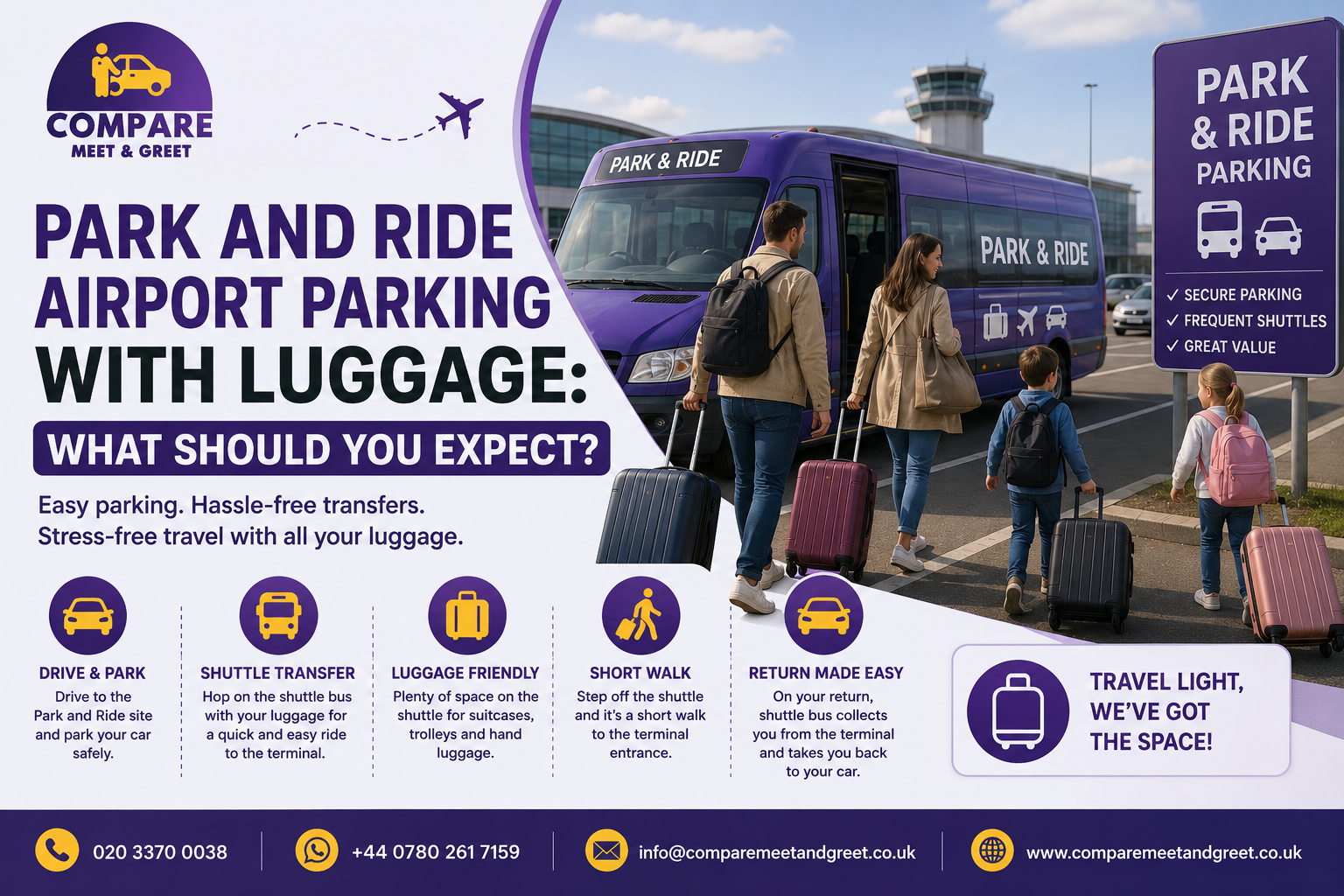
Park and ride airport parking with luggage is usually straightforward when you have wheeled suitcases, a short walk to the bus stop and a frequent shuttle. However, it involves more luggage handling than parking near the terminal or using Meet and Greet. You must unload everything at the car park, move it to the shuttle, load or position it safely, remove it at the terminal and repeat the process after your return flight.
The experience can change significantly according to the car park. A self-park site may require a walk from your bay to the nearest bus stop. An operator-parked service may let you unload beside reception before staff move the vehicle. Shuttle buses may have luggage racks, floor-level storage or a separate luggage area, but capacity and rules vary.
Before booking, compare the bus frequency, walking distance, luggage arrangements, accessibility, terminal drop-off point and any restrictions on oversized items. If you are travelling with multiple heavy cases, a pushchair, sports equipment or mobility aids, the cheapest parking option may not be the easiest.
This guide explains the complete luggage journey, what to prepare and when another type of airport parking could offer better value.
Can You Use Park and Ride Airport Parking With Luggage?
Yes. Park and Ride is designed for airport passengers, so ordinary holiday luggage can generally be carried on the shuttle. Most travellers use it with suitcases, cabin bags and personal items.
However, “luggage accepted” does not mean every item, size or quantity is automatically suitable. Vehicle layouts, passenger capacity and provider policies differ. Confirm the rules if you are carrying:
- several large suitcases;
- a pushchair or travel system;
- a wheelchair or mobility aid;
- skis, snowboards or golf clubs;
- surfboards or other long equipment;
- bicycles;
- musical instruments;
- boxes or commercial goods;
- a travel cot; or
- unusually heavy or fragile items.
The practical question is not only whether the shuttle accepts the luggage. It is whether you and the people travelling with you can safely move every item from the car to the bus and from the bus into the terminal.
How Does Park and Ride Work When You Have Luggage?
The typical process is:
- Drive to the booked Park and Ride car park.
- Enter using number-plate recognition, a code, ticket or reception.
- Park in a bay or leave the car with the operator.
- Remove all luggage needed for the trip.
- Walk to the shuttle stop or reception area.
- Wait for and board the correct airport bus.
- Load or position luggage as directed.
- Travel to the terminal and unload every item.
- After the return flight, find the pickup point with your luggage.
- Take the shuttle back and reload the vehicle.
Compared with terminal parking, the main difference is the transfer. Each bag must be handled several additional times. This is manageable with ordinary wheeled cases but can become tiring with bulky or loose items.
What Happens When You Arrive at the Car Park?
Arrival depends on whether the service is self-park or operator-parked.
Self-park services
You enter, find a space and unload at the bay. You then carry or wheel the luggage to the nearest bus stop.
Before choosing a space, consider:
- how far it is from the stop;
- whether the path is level;
- whether everyone can move safely through the car park;
- weather conditions; and
- whether luggage trolleys are provided.
Do not assume a trolley will be available. Pack so you can move the luggage without one unless the provider specifically confirms otherwise.
Make a clear note of the zone, row, bay and nearest bus stop. Photograph the location so you can return to the vehicle without walking around the car park with all your cases.
Operator-parked services
You normally drive to an arrivals lane or reception area, unload there and leave the keys with staff. This can reduce the distance you carry luggage, although the service may involve a check-in queue.
Unload everything before handing over the car. Once staff move the vehicle, retrieving a forgotten item may be difficult and could delay your transfer.
Check the boot, rear seats, door pockets and charging areas. Keep passports, medication, phones and booking details with you.
How Far Will You Carry Your Luggage?
The answer varies by car park. At a compact operator-parked site, the bus may stop beside reception. At a large self-park facility, you may walk from your bay to one of several internal stops.
The advertised transfer time does not normally include this walk. When comparing products, check:
- distance from parking bays to bus stops;
- number and location of stops;
- surface quality and kerbs;
- covered or uncovered routes;
- lighting for overnight travel;
- accessible bays; and
- whether staff assistance or trolleys are available.
If the website does not provide enough detail and walking distance matters, contact the operator before booking.
How Is Luggage Stored on the Shuttle Bus?
Airport parking buses use different layouts. Luggage may be placed:
- in internal racks;
- in designated floor-level spaces;
- in an external or underfloor hold;
- in a separate trailer; or
- where the driver directs passengers.
Follow staff instructions and keep aisles, doors and emergency exits clear. Do not place a heavy suitcase on a seat unless the operator permits it, and do not leave a bag where it could move as the bus turns or stops.
Keep essential and valuable items under your control. Passports, money, phones, laptops, medication and car park documents should stay in a small personal bag rather than being placed among large suitcases.
Before leaving the bus, check the luggage area, seats and floor. A similar-looking black suitcase can easily be taken by mistake, so use a distinctive luggage tag or strap.
Do Shuttle Bus Drivers Help With Luggage?
Assistance differs by provider, staff member, vehicle and individual circumstances. A driver may help when possible, but you should not assume that someone will lift every case.
Pack on the basis that you may need to move the luggage yourself. If you cannot lift or handle an item safely, contact the provider in advance to ask what assistance is available and whether the transfer is suitable.
Passengers requiring accessibility support should verify the arrangements before booking. This can include ramp access, wheelchair space, assistance points and the location of accessible parking bays.
How Much Luggage Can You Take on a Park and Ride Shuttle?
There is no universal allowance across all airport parking services. Ordinary airline luggage is generally expected, but an operator may restrict oversized, excessive or unsafe items.
Your airline’s baggage allowance and the parking shuttle’s practical capacity are separate issues. An item accepted by the airline is not automatically easy to carry on every transfer bus.
Check the provider’s terms if:
- each passenger has multiple checked cases;
- the group has more bags than people can manage;
- any item is unusually long or wide;
- equipment needs special handling;
- luggage cannot be stacked or stored safely; or
- you are travelling during a busy period.
Where the policy is unclear, obtain confirmation before paying.
Is Park and Ride Suitable for Heavy Suitcases?
It can be, particularly when cases have reliable wheels and the walking route is short and level. The difficulty increases when:
- one person must handle several cases;
- bags have broken or small wheels;
- the route includes kerbs or uneven surfaces;
- the bus is busy;
- cases must be lifted into high racks; or
- there is no assistance.
Check the weight of each case before leaving home. A suitcase that is within an airline limit can still be uncomfortable to lift repeatedly.
Use luggage with secure handles and test the wheels. Avoid attaching loose carrier bags, coats or pillows that can fall off while moving between the car and bus.
Park and Ride With Cabin Bags Only
Park and Ride is often easiest with cabin luggage. A traveller with one wheeled case and a small personal bag can move quickly between the vehicle, shuttle and terminal.
Even then, keep valuables secure and avoid blocking the aisle. If the bus is busy, place the cabin case in the designated luggage area rather than holding it where it could cause an obstruction.
For a brief trip, compare the Park and Ride saving with a closer car park. The difference may be small enough that walking from a terminal car park provides better value.
Park and Ride With Pushchairs and Travel Systems
Pushchair policies and bus layouts vary. You may be required to fold the pushchair and place it in the luggage area. Large travel systems can take considerable space and may be awkward alongside suitcases.
Before booking, check:
- whether the pushchair must be folded;
- whether step-free boarding is available;
- the amount of luggage space;
- whether a travel system is treated as an oversized item;
- whether assistance is available; and
- the walking distance from the bay to the stop.
Practise folding the pushchair quickly. Remove loose accessories, toys and cup holders, and consider an appropriate travel cover or securing strap.
Families should also think about who supervises the children while the luggage and pushchair are loaded. When two adults travel, decide in advance who handles the equipment and who stays with the children.
For detailed family planning, compare the practical points in our guide to Park and Ride airport parking for families once it is published.
Park and Ride With Wheelchairs or Mobility Equipment
Do not assume all shuttle vehicles or stops provide identical access. Contact the car park before booking to confirm:
- accessible parking bay locations;
- step-free routes;
- ramp or lift availability;
- wheelchair spaces;
- whether the mobility device must be folded;
- maximum dimensions or weight;
- assistance arrangements; and
- the accessibility of the terminal drop-off point.
If the transfer cannot meet the traveller’s needs, compare terminal parking, an airport assistance service or another suitable product. The cheapest parking has no value if the group cannot use it safely.
Park and Ride With Sports Equipment
Skis, golf clubs, surfboards, bicycles and other sports equipment can be long, heavy or difficult to secure. Providers may impose restrictions because the shuttle must carry other passengers and keep exits clear.
Before booking, provide the operator with the item type, dimensions and quantity. Ask whether advance notice or a separate transfer is required.
Protect the equipment in an appropriate case. Do not rely on the driver having straps, padding or specialist storage.
If the shuttle does not accept the item, consider:
- terminal parking;
- Meet and Greet;
- dropping the equipment and another adult at an authorised terminal area first; or
- arranging an alternative transfer.
Remember that airport drop-off fees and time limits may apply if the group splits the journey.
Travelling Alone With Multiple Bags
One traveller with several bags needs to consider every point at which the luggage must be left or moved. It may be difficult to supervise luggage while placing cases in a rack, checking in at reception or finding the parked vehicle after returning.
Park and Ride can still work if:
- cases have good wheels;
- all items can be moved together;
- the route is short and accessible;
- buses are frequent; and
- the luggage can be lifted safely.
Avoid packing several loose bags. Consolidate where possible without exceeding airline allowances. A luggage strap can keep a smaller item attached to a wheeled case, provided it remains stable and does not create a hazard.
If you cannot independently move everything, select a closer product or confirm assistance before booking.
Using Park and Ride With Family Luggage
Family luggage adds both volume and supervision needs. Adults may be managing suitcases, cabin bags, pushchairs, changing bags, travel cots and car seats while keeping children safe near moving vehicles.
Good preparation includes:
- assigning one adult to the children and one to luggage;
- reducing loose items;
- keeping essentials in one accessible bag;
- counting every item at each stage;
- using distinctive tags;
- checking pushchair arrangements; and
- allowing extra transfer time.
One adult could drop the family and most luggage at an authorised terminal drop-off zone before driving to Park and Ride. This can simplify the shuttle journey, but it may add a terminal fee, driving time and separation. Compare the total cost and use only permitted areas.
What Happens to Luggage at the Terminal?
The shuttle will stop at an authorised airport location. This could be outside the terminal, at a coach station or at a transport interchange connected by a walkway.
The advertised bus journey may not include the walk from the stop to check-in. With heavy luggage, investigate:
- distance to departures;
- lifts and level access;
- availability of airport luggage trolleys;
- covered routes; and
- whether the bus serves the departure terminal directly.
Unload every item before the bus leaves. Count the bags and check that you have not picked up another passenger’s luggage.
What Should You Expect on the Return Journey?
After landing, you normally collect checked luggage before travelling back to the car park. Depending on the service, you may go directly to a scheduled bus stop or call the operator after baggage reclaim.
The return can be more difficult because:
- passengers may be tired;
- bags may feel heavier;
- the shuttle stop may be unfamiliar;
- weather conditions may have changed;
- several flights may arrive together; and
- the car park may be dark.
Before travelling, save the return instructions and photograph your parking location. Keep coats accessible and ensure phone batteries are sufficient to contact the provider.
At the car park, unload every item before the bus departs. If you used a self-park service, get off at the stop nearest your recorded zone. If staff hold the keys, take the luggage to the stated collection area.
What If Your Flight Is Delayed and You Have Luggage?
A delay can affect shuttle frequency, staffing and parking charges, particularly overnight. Read the late-return policy before booking.
After landing, collect all luggage before calling an on-demand provider unless the instructions say otherwise. Airport pickup zones may not allow a shuttle to wait while you remain at baggage reclaim.
If a bag is delayed or missing, contact the car park if the wait will significantly change your collection time. Retain the booking reference and provider number in hand luggage.
How Much Extra Time Should You Allow With Luggage?
There is no universal answer. Add together:
Car park entry + parking or reception + unloading + walk to the stop + bus wait + transfer + walk to check-in
Heavy, bulky or numerous items increase the time required at every stage. Follow the provider’s recommended allowance and add a sensible buffer. This is in addition to the airport’s advice about when to reach check-in or security.
On return, do not use the scheduled landing time as the car park exit time. Allow for disembarking, passport control, baggage reclaim, the walk to the pickup point, the shuttle and vehicle loading.
Park and Ride vs Meet and Greet With Luggage
Meet and Greet usually reduces luggage handling because the handover takes place at or near a designated terminal location. Park and Ride normally costs less but requires the bus transfer in both directions.
| Luggage consideration | Park and Ride | Meet and Greet |
|---|---|---|
| Unloading point | Remote car park | Usually near the terminal |
| Shuttle required | Yes | Usually no |
| Number of luggage movements | More | Fewer |
| Keys | Keep or leave, depending on product | Usually leave |
| Typical price position | Often lower | Often higher |
| Often better for | Manageable wheeled luggage | Heavy, bulky or multiple items |
Compare live prices for identical times. If Meet and Greet costs only a little more, avoiding two shuttle transfers may offer better overall value.
Airport-specific comparisons are available for Heathrow Meet and Greet airport parking, Gatwick Meet and Greet airport parking, Manchester Meet and Greet airport parking and Bristol Meet and Greet airport parking.
Park and Ride vs Long Stay With Luggage
Long Stay and Park and Ride often use a similar shuttle process. At some airports they can be the same product under different names. Heathrow, for example, renamed official Long Stay parking Park & Ride.
Compare the actual service:
- Is the car park self-park?
- How far are bays from bus stops?
- Do you keep the keys?
- How frequently do buses run?
- Where does the bus stop at the terminal?
- Is luggage assistance available?
- Are oversized items permitted?
Read the Heathrow Long Stay parking guide for airport-specific context. For short visits where walking distance matters more than price, Heathrow Short Stay parking may provide a more relevant comparison.
How to Pack for an Easier Park and Ride Transfer
Use wheeled cases in good condition
Test wheels, handles and zips before travel. A broken wheel can turn a short walk into a difficult one.
Reduce loose items
Carrier bags, pillows, coats and toys are easy to drop or forget. Attach items securely or place them inside a case.
Add distinctive luggage identification
Use a strong tag, strap or recognisable cover. Include contact information without displaying unnecessary personal details.
Keep essentials together
Place passports, medication, phones, wallets, keys and booking details in one small bag that remains with you.
Distribute weight sensibly
Avoid creating one case that nobody can lift. Stay within airline limits and pack so the travelling group can manage every item.
Protect fragile equipment
Use appropriate cases and padding. A general shuttle service may not provide specialist handling.
Count bags at every stage
Count when leaving the car, boarding, leaving the bus, collecting baggage and returning to the vehicle.
Common Mistakes When Using Park and Ride With Luggage
Assuming a trolley will be available
Some car parks do not provide luggage trolleys. Plan to move your bags independently unless confirmed otherwise.
Packing too many loose bags
Loose items are harder to count and manage. Consolidate them before leaving home.
Leaving an essential item in the car
Check the boot and passenger areas before the vehicle is locked or handed to staff.
Forgetting the bay or bus stop
Photograph the parking location. This prevents unnecessary walking with luggage after the return flight.
Ignoring oversized-item rules
Airline acceptance does not guarantee shuttle acceptance. Ask the provider about large equipment.
Underestimating the transfer time
The bus journey is only one part of the process. Include unloading, walking and waiting.
Putting valuables in the main luggage area
Keep passports, money, medication and electronics under your control.
Park and Ride With Luggage: Booking Checklist
Before paying, confirm:
- The shuttle serves the correct terminal.
- Transfers are included for all passengers.
- The bus runs at the required times.
- You know the frequency and approximate journey time.
- Your luggage type and quantity are accepted.
- Oversized equipment has been approved.
- Accessible arrangements meet your needs.
- You can move all items without relying on a trolley.
- You understand whether you keep or leave the keys.
- The terminal stop is suitable for heavy luggage.
- Cancellation and late-return terms are acceptable.
- The total saving justifies the extra handling.
Before leaving the vehicle:
- Count all luggage.
- Remove travel documents and valuables.
- Check the boot, seats and door pockets.
- Record the parking zone and stop.
- Secure loose items.
- Confirm the bus destination.
Frequently Asked Questions
Can you take suitcases on a Park and Ride airport shuttle?
Yes, ordinary airport luggage is generally expected. Storage layout and capacity vary, so check the provider if you have several cases or unusually large items.
Is there a luggage limit on Park and Ride buses?
There is no single limit covering every provider. Some operators may restrict excessive, heavy or oversized luggage. Read the booking terms or contact the provider.
Do Park and Ride shuttle drivers help with luggage?
Assistance varies and should not be assumed. Pack so you can handle your own luggage, or confirm support in advance if you require help.
Can you take a pushchair on a Park and Ride shuttle?
Often, but it may need to be folded and stored in a designated area. Check the specific vehicle and provider policy before booking.
Can you take golf clubs or skis on a Park and Ride bus?
It depends on available space and the operator’s rules. Obtain confirmation for long or bulky sports equipment before paying.
Are luggage trolleys available at Park and Ride car parks?
They may not be. Unless the provider explicitly confirms trolley availability, assume you need to move the luggage yourself.
Is Meet and Greet better when you have heavy luggage?
It can be because you normally unload near the terminal and avoid the shuttle. Compare the price difference with the time and physical effort saved.
How early should you reach Park and Ride with luggage?
Follow the provider’s guidance and allow time for entry, parking or check-in, unloading, walking, waiting and travelling to the terminal. Add more time for bulky or numerous bags.
What happens to luggage if a return flight is delayed?
You collect checked luggage at the terminal as normal and then follow the car park’s return instructions. If baggage delays affect the pickup significantly, contact the operator where required.
Is Park and Ride suitable for one person with multiple cases?
It can be if the cases have good wheels and can be moved and lifted safely. Otherwise, terminal parking or Meet and Greet may be more practical.
Park and Ride Airport Parking With Luggage: The Verdict
Park and ride airport parking with luggage is practical for most passengers carrying ordinary wheeled suitcases and cabin bags. The key difference from terminal parking is that every item must travel between the car and shuttle in both directions.
Before booking, consider the number and weight of bags, walking distance, bus layout, transfer frequency and terminal drop-off point. Ask the provider about pushchairs, wheelchairs, sports equipment and other oversized items rather than assuming they will fit.
Park and Ride can offer strong value when the luggage is manageable and the transfer is frequent. When the group has several heavy cases, limited mobility or bulky equipment, paying more for Meet and Greet or closer terminal parking may make the complete journey easier.