
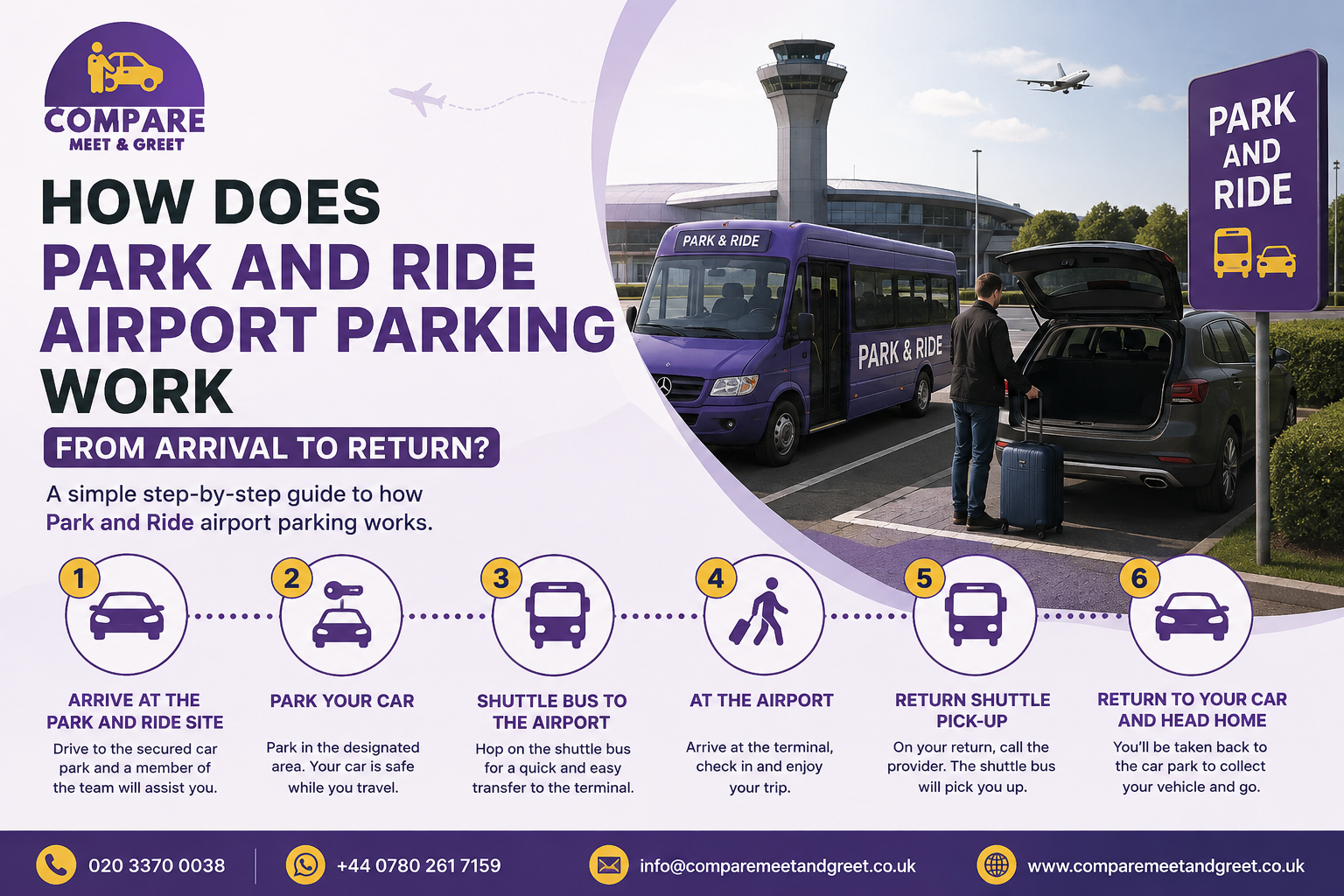
How does park and ride airport parking work? You drive to a car park away from the airport terminal, park your vehicle or check it in with the operator, and take an included shuttle bus to departures. When you return, you travel back to the car park on the shuttle, collect your car or keys and drive home.
The basic idea is straightforward, but the exact process varies. Some car parks use automatic number-plate recognition and let you choose a bay and keep your keys. Others have a reception area where you check in, hand over the keys and allow staff to park the vehicle. Shuttle buses may follow a timetable, run every few minutes or operate on demand.
Knowing what happens at each stage helps you arrive with enough time, find the correct transfer, avoid booking mistakes and understand what to do after landing. This guide follows the entire park and ride journey from choosing a product to leaving the car park after your return flight.
How Does Park and Ride Airport Parking Work? The Short Answer
Park and ride airport parking normally works in eight stages:
- Compare and pre-book a car park for your airport, terminal and travel times.
- Follow the provider’s directions to the car park.
- Enter using number-plate recognition, a barcode, ticket or reception check-in.
- Park the car yourself or leave the keys with the operator.
- Take the shuttle bus to your departure terminal.
- After your return flight, follow the collection instructions.
- Take the shuttle bus back to the car park.
- Find or collect your car, exit and drive home.
The transfer is commonly included in the booking price, but you should verify this before paying. You should also check bus frequency, journey time, opening hours, terminal coverage, key policy and late-return terms.
What Is Park and Ride Airport Parking?
Park and ride is a form of airport parking located away from the terminal building. Instead of walking directly from the car to check-in, passengers use a shuttle bus for the final part of the journey.
The car park may be:
- on the airport estate but too far from the terminal to walk;
- just outside the airport boundary;
- several miles away on a major approach road; or
- operated by the airport, an independent parking company or a third-party provider.
Because it uses land farther from the terminal, park and ride is often priced below Short Stay, premium multi-storey and Meet and Greet parking for longer trips. The trade-off is the extra time and handling involved in the shuttle transfer.
At some airports, a similar service is called Long Stay parking. Heathrow, for example, renamed its official Long Stay product Park & Ride. Elsewhere, Long Stay may remain the airport’s name for a shuttle-connected car park. Always compare how the service works rather than relying only on the product label.
Before You Book: Choose the Right Park and Ride Service
The process begins before you reach the airport. A suitable booking should match your airport, terminal, vehicle, flight times and practical requirements.
Enter the time you expect to arrive at the car park—not the time your flight leaves. For the return, enter the time you expect to exit the car park rather than the scheduled landing time. Allow for passport control, baggage reclaim, walking to the bus stop, waiting for the shuttle and travelling back to your vehicle.
Before booking, compare:
- the final price for the full stay;
- exact car park address;
- terminals served;
- shuttle frequency and journey time;
- whether transfers are included for every passenger;
- whether you park the car yourself;
- whether you keep or leave the keys;
- cancellation and amendment rules;
- late-return charges and any grace period;
- vehicle size restrictions;
- opening hours; and
- accessibility arrangements.
The cheapest headline price may not be the best choice if the transfer is unsuitable or the terms are too restrictive.
After Booking: What Information Will You Receive?
The provider should send a confirmation by email or make it available through your account. Save it somewhere you can access even if mobile reception is poor.
Your confirmation should contain most or all of the following:
- booking reference;
- car park name and full address;
- postcode and driving directions;
- booked arrival and exit times;
- registered vehicle details;
- entry method;
- terminal transfer information;
- key-handover instructions, if applicable;
- return pickup point;
- contact telephone number; and
- instructions for delays or changes.
Read the confirmation before travel. Do not rely exclusively on a postcode entered into satellite navigation because airports may have multiple entrances, temporary diversions or similarly named car parks. Follow the route supplied by the provider where possible.
Check that your number plate and vehicle details are correct. An incorrect registration could prevent automatic entry or create problems when leaving.
On the Day: Driving to the Park and Ride Car Park
Leave enough time to reach the parking facility without rushing. Your airport arrival plan needs to include the full park and ride process in addition to the airport’s recommended check-in allowance.
Potential delays before the shuttle include:
- traffic near the airport;
- missing the car park entrance;
- queues at barriers or reception;
- finding a parking space;
- unloading luggage;
- walking to the bus stop; and
- waiting for the next transfer.
Keep the confirmation and contact number accessible. If possible, save the car park location in advance rather than searching while driving.
When approaching the airport, follow signs for the named parking product rather than general signs for Short Stay, Drop-off or Meet and Greet. Entering the wrong airport zone can lead to additional charges and make you late.
Arriving at the Car Park: How Do You Enter?
Entry procedures vary between products. The most common methods are automatic number-plate recognition, barcode or QR-code scanning, taking a ticket, and reception check-in.
Automatic number-plate recognition
ANPR reads the registration entered during booking and opens the barrier after finding the reservation. Approach slowly and allow the camera time to recognise the plate.
If the barrier does not open, use the help button rather than taking a new ticket unless the instructions explicitly tell you to do so. Taking an unlinked ticket could make the system treat you as a drive-up customer.
Barcode or QR code
Some car parks ask you to scan a code from the confirmation. Increase the brightness on your phone or keep a printed copy if recommended.
Ticketed entry
A booking may require you to take a ticket and retain it for departure. Keep the ticket somewhere safe and away from items that could damage it.
Reception check-in
Operator-parked services may direct you to an arrivals lane or designated bay. You then report to reception with your booking reference and vehicle information.
Follow the method stated in your confirmation, even if you have used a different airport car park before.
Do You Park Your Own Car?
There are two main park and ride models.
Self-park and keep your keys
You enter the car park, find an available bay, park, lock the vehicle and take the keys with you. Make a clear note of the zone, row and nearest bus stop. Photographing the bay marker can make the car easier to find after a long trip.
Before leaving the vehicle:
- close all windows;
- switch off lights and electrical accessories;
- remove visible valuables;
- lock the doors;
- check you have travel documents and medication; and
- confirm the parking brake is applied.
Do not leave prohibited or dangerous items in the car.
Operator-parked and leave your keys
You park in a reception or arrivals area, unload your luggage and hand over the keys. Staff then move the vehicle to a parking bay.
Before handover, it is sensible to:
- photograph the exterior;
- note the mileage and fuel or charge level;
- remove house keys and unrelated keys from the ring;
- remove valuables; and
- keep the receipt or collection document.
Read the terms to understand where the vehicle may be parked and whether it can be moved during the stay. Leaving your keys is not limited to Meet and Greet; some park and ride sites also use this method.
Finding and Boarding the Shuttle Bus
After parking or checking in, follow the signs to the shuttle stop. At a large self-park site, use the stop nearest your bay and record its number for the return.
The bus service may:
- run to a published timetable;
- arrive at regular intervals;
- circulate continuously;
- depart when passengers are ready; or
- require a telephone call outside normal hours.
Before boarding, confirm that the bus serves your terminal. At airports with several terminals, one route may make multiple stops or separate buses may operate.
Load luggage only where directed. Keep travel documents, phones, wallets, medication and valuables with you rather than placing them where they could be left behind.
If you need step-free access, wheelchair space or help with luggage, confirm arrangements before booking rather than waiting until departure day.
How Long Does the Transfer Take?
Transfer time depends on the location, terminal, route and traffic. A provider may advertise a journey of five, 10, 15 or more minutes, but this normally represents time on the bus.
Your complete parking-to-terminal time is:
Entry and parking + unloading + walk to bus stop + waiting time + shuttle journey + walk to departures
This means a car park with a 10-minute bus journey could require 30 minutes or more from arrival to terminal access. Build in a buffer, especially during school holidays, early-morning peaks and periods of disruption.
Bus frequency matters as much as the advertised transfer. A 15-minute journey with buses every 10 minutes could be more predictable than a five-minute transfer operating every 30 minutes.
What Happens When the Bus Reaches the Airport?
The shuttle drops passengers at an authorised stop serving the relevant terminal. This may be immediately outside the building, at a transport interchange or a short walk from departures.
Before leaving the bus:
- check the seats and luggage area;
- take every bag;
- confirm you have your phone and documents; and
- note the return stop if it is clearly marked.
From there, follow airport signs to check-in, bag drop or security.
Save the return instructions before flying. Outbound and inbound bus stops may be in different locations, and the return process may require a call after baggage reclaim.
What Happens to Your Car While You Are Away?
With a self-park product, the car normally remains in the bay you selected. With an operator-parked product, staff move it from the arrivals area to a storage bay and may reposition it for collection.
The exact arrangements are governed by the provider’s terms. Review stated parking locations and vehicle-movement policies before booking.
Do not assume every car park offers identical facilities or monitoring. If a particular feature matters to you, check the provider’s published information and verify any claimed independent accreditation where practical.
What Should You Do Before Your Return Flight?
Most travellers do not need to contact the car park before flying home unless the provider requests confirmation or the flight details have changed.
Check your booking if:
- the return flight number changes;
- you will arrive on a different date;
- the landing time changes substantially;
- the airline moves you to another airport or terminal; or
- you need to extend the parking period.
Use the provider’s amendment or contact process as soon as possible. Do not assume the car park will automatically receive every airline update.
Keep the collection receipt, booking reference and car park contact number in your hand luggage rather than checked baggage.
After Landing: When Should You Contact the Car Park?
Follow the provider’s instructions. The required timing commonly falls into one of three models.
No call required
Official Long Stay-style services often use scheduled buses. After collecting luggage, you go directly to the stated bus stop.
Call after baggage reclaim
Some independent Park and Ride providers ask passengers to telephone only after collecting all luggage. This prevents the shuttle being dispatched while you are still inside the terminal.
Call after clearing the terminal
An on-demand service may ask you to call from a particular exit or pickup zone. Give the information requested, which could include your name, booking reference, terminal and passenger count.
Do not call too early unless instructed. Passport control and baggage reclaim can be unpredictable, and a bus may be unable to wait in a restricted airport pickup area.
Where Do You Catch the Return Shuttle?
The return bus stop should be listed in the booking confirmation. Airports may use numbered stops, coach stations, transport interchanges or dedicated parking-bus zones.
Airport signs can change, so also check any current instructions issued by the provider. If unsure, contact the car park rather than boarding a bus with a similar name.
At Heathrow, for example, the correct Park & Ride pickup location varies by terminal. Gatwick Long Stay, Manchester JetParks and Bristol Silver Zone also use their own designated routes or collection points. Airport-specific details should always be rechecked close to travel.
When boarding, confirm the destination with the driver. Some buses serve several zones or car parks.
Returning to a Self-Park Car Park
If you kept the keys, get off at the stop nearest your parking zone. Use the row number, bay marker or photograph saved before departure to locate the vehicle.
Before driving away:
- inspect the vehicle;
- load luggage safely;
- check tyres visually;
- make sure all passengers are seated;
- set navigation before moving; and
- follow exit signs.
At the barrier, ANPR may recognise the booking automatically. Alternatively, you may need to insert a ticket, scan a code or validate the ticket according to the instructions.
If the barrier requests an unexpected payment, use the assistance button and provide your reference. Do not pay immediately unless the charge is valid and explained.
Returning to an Operator-Parked Car Park
If you left the keys, go to reception or the stated collection area. Present the receipt, booking reference or identification required by the provider.
Your car may be waiting near reception or staff may direct you to its bay. Before leaving:
- inspect the vehicle in reasonable light;
- compare its condition with your handover photographs;
- check the mileage if recorded;
- ensure all keys are returned; and
- report any concern before exiting, following the provider’s procedure.
Allow time for collection, especially when several flights land close together.
What Happens If Your Return Flight Is Delayed?
Flight delays are common enough that you should read the late-return policy before booking. Some products include a grace period; others charge for additional hours, a part-day or another full day.
If you know you will exit after the booked time:
- Check the confirmation and terms.
- Contact the provider if instructed.
- Update the booking online when possible.
- Keep evidence of any agreed extension.
Entering a flight number can help the provider identify a delay, but it does not guarantee that extra parking will be free. The booking conditions determine any charge.
What If You Return Earlier Than Planned?
The process depends on whether the product is self-park or operator-parked. With self-park parking, you may be able to collect the vehicle and leave normally. If staff hold the keys or store vehicles in another area, contact the operator so the car can be prepared.
Early return does not usually mean an automatic refund for unused parking. Check the terms for the specific booking.
Park and Ride at Major UK Airports
Heathrow Airport
Heathrow’s official Long Stay product was renamed Park & Ride. It uses shuttle buses, and the correct car park and journey time depend on the terminal.
Review Heathrow Long Stay parking to understand the relationship between the names. For terminal-focused alternatives, compare Heathrow Meet and Greet airport parking and Heathrow Short Stay parking.
Gatwick Airport
Gatwick’s official Long Stay service uses shuttle buses, while independent operators around the airport may sell Park and Ride products. Confirm whether the service covers North Terminal, South Terminal or both.
If you want to avoid the transfer stage, compare Gatwick Meet and Greet airport parking for the same dates.
Manchester Airport
Manchester JetParks is a value-focused shuttle parking range. The precise car park and terminal connection depend on the selected product and current availability.
Travellers prioritising terminal access can compare Manchester Meet and Greet airport parking.
Bristol Airport
Bristol Airport’s Silver Zone illustrates the operator-parked model: customers check in, leave the keys and take a courtesy shuttle. The process differs from a self-park, keep-your-keys product.
Compare it with Bristol Meet and Greet airport parking if handling luggage on a shuttle is a concern.
How Is Park and Ride Different From Meet and Greet?
With Park and Ride, you drive to a car park away from the terminal and take a bus. With a genuine Meet and Greet service, you normally drive to a designated terminal-area handover point, meet or check in with the operator, leave the keys and walk to departures. The operator parks the car elsewhere.
| Feature | Park and Ride | Meet and Greet |
|---|---|---|
| Where you drive | Remote car park | Designated terminal-area handover point |
| Transfer | Shuttle bus | Usually a short walk |
| Keys | Keep or leave | Usually leave |
| Typical priority | Lower price | Greater convenience |
| Return | Bus back to car park | Collect near the agreed terminal location |
Park and Ride is often cheaper, while Meet and Greet may suit families, passengers with heavy luggage or travellers who value time more than the lowest price.
Common Park and Ride Mistakes to Avoid
Using the flight time as the parking arrival time
Your booking should start when you plan to reach the car park, well before departure. You still need to transfer and complete airport check-in.
Entering the landing time as the car park exit time
You cannot normally leave the car park immediately after landing. Allow for the entire arrivals and return-transfer process.
Following the wrong airport signs
Use the directions for your named car park. Short Stay, Drop-off, Long Stay, Park and Ride and Meet and Greet entrances may be separate.
Forgetting the parking location
Save the zone, row, bay and nearest bus stop. Large car parks can be difficult to navigate after a long journey.
Assuming you keep the keys
Check the product description. Park and Ride can be self-park or operator-parked.
Ignoring overnight shuttle arrangements
Check whether buses run regularly, less frequently or on demand at your travel times.
Failing to read the return instructions
Know whether you should call, which stop to use and what documents are required to collect the car.
Park and Ride Airport Parking Checklist
Before leaving home:
- Confirm the airport, terminal and car park.
- Check vehicle details and registration.
- Save the directions and booking reference.
- Confirm the key policy.
- Review shuttle hours and frequency.
- Allow enough time before check-in.
- Save the contact number.
After parking:
- Lock and check the vehicle.
- Record the zone, row and bus stop.
- Keep valuables and travel documents with you.
- Confirm the shuttle serves your terminal.
After landing:
- Collect all luggage before calling if required.
- Follow the stated pickup instructions.
- Confirm the bus destination.
- Inspect and collect the vehicle before exiting.
Frequently Asked Questions
How does park and ride airport parking work?
You drive to a car park away from the terminal, park or check in the vehicle, and take a shuttle bus to departures. After returning, you take the shuttle back, collect your car or keys and exit the car park.
Is the shuttle included with park and ride parking?
It commonly is, but always verify the individual product. Check whether every passenger is covered and whether the bus serves your terminal at the required times.
Do you park your own car with Park and Ride?
Some services are self-park, while others require you to leave the vehicle and keys for staff to park. The product description should explain the process.
Do you keep your keys with Park and Ride?
It depends on the service. Keep-your-keys products let the car remain in the bay you select. Operator-parked products normally require the keys so staff can move the vehicle.
How early should you arrive at a Park and Ride car park?
Follow the provider’s recommended allowance. Include time for entry, parking or check-in, unloading, walking to the bus stop, waiting and travelling to the terminal in addition to the airport’s check-in guidance.
How often do Park and Ride buses run?
Frequency varies. Buses may run every few minutes, follow a timetable or operate on demand. Overnight arrangements can differ from daytime service, so check your booking details.
What happens when you return from holiday?
After collecting your luggage, follow the provider’s instructions. You may go directly to a bus stop or call for pickup. The shuttle returns you to the car park, where you find your car or collect the keys.
What happens if a flight is delayed?
Some bookings include a grace period, while others charge for extra hours or another day. Check the late-return conditions and contact the provider if required.
Is Park and Ride the same as Long Stay parking?
Sometimes. Many Long Stay car parks use a park-and-ride system, and some airports use the two terms for the same product. At other airports, they can be separate services.
Is Park and Ride suitable for families?
It can provide good value, but consider the practical bus transfer with children, pushchairs, car seats and luggage. Compare Meet and Greet if avoiding a shuttle would significantly simplify the journey.
Is Park and Ride Airport Parking Right for You?
Park and Ride is often a suitable option when you want affordable airport parking and are comfortable adding a shuttle transfer. It works particularly well for multi-day holidays, provided the car park location, timetable, key policy and booking conditions meet your needs.
It may be less convenient if you have several small children, bulky luggage, limited mobility or very little time. In those situations, compare the saving with Long Stay, Short Stay and Meet and Greet options.
The most important step is to read the individual service details. Park and Ride products do not all use the same entry method, bus schedule or vehicle-handling process.
From Arrival to Return: The Park and Ride Process Made Simple
So, how does park and ride airport parking work from beginning to end? You book a suitable product, drive to the remote car park, enter using the stated method, park or hand over the vehicle, and use a shuttle bus to reach the terminal. After your trip, you follow the return instructions, take the shuttle back and collect the car.
The process is simple when you know the address, allow enough time and save the return information. Before booking, compare the complete price, transfer frequency, terminal coverage, key policy and flexibility. A few checks in advance can make Park and Ride a practical and cost-effective start and finish to your journey.